Most golf cart owners bolt on a mirror and call it done. But a mirror that's pointed at the sky or angled too far inward is barely better than no mirror at all. Taking five minutes to properly adjust every mirror on your cart — rear view and side mirrors alike — makes a real difference in situational awareness, especially at higher speeds on paths, in neighborhoods, or around pedestrians. This guide walks you through the process the right way.
Understand What Each Mirror Should Cover
Before you start turning any hardware, know what you're aiming for. A center rear view mirror should give you a clean, unobstructed view directly behind the cart through the center of the rear opening or across the rear of the roof. Side mirrors — when present — should extend your field of view outward to cover the areas your rear view mirror can't reach: the rear corners and anything coming up alongside you. Together, they should overlap slightly so there are no dead zones between them. If you can see the same patch of asphalt in all three mirrors, you've overlapped too much; if there's a gap, you have a blind spot.
Start with the Rear View Mirror
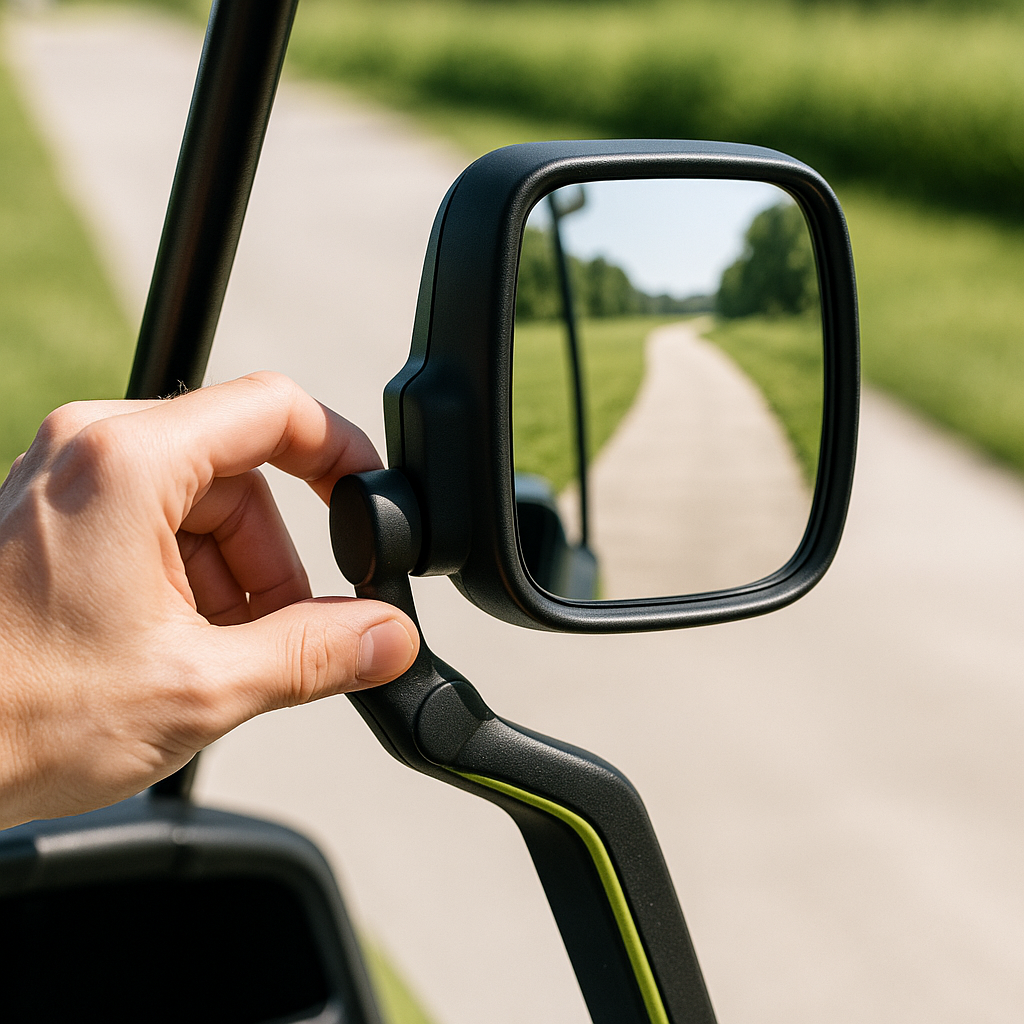
Sit in your normal driving position before touching anything — posture matters here. Loosen the mounting hardware just enough so the mirror moves with moderate resistance, but won't flop freely. Tilt the mirror up or down until the horizon line sits near the upper third of the mirror face. Then rotate it left or right so the view is centered behind you, not canted to one side. When you're satisfied, snug the hardware back down firmly. Check it again from your seated position after tightening — mirrors sometimes shift slightly when hardware is torqued.
Adjust Side Mirrors Next
Side mirrors should be set after the rear view mirror, since you're filling in the gaps the center mirror leaves. Sit in the driver's seat again. Adjust each side mirror so that you can just barely see the rear edge of the cart body in the innermost portion of the mirror — that thin sliver of cart gives you a reference point. The rest of the mirror face should show the lane or path behind and beside you. Angle the mirror face slightly downward so you also get some visibility of the ground near the rear wheels, which is useful in tight maneuvering situations.
Check Hardware Tightness and Stability
A mirror that vibrates or droops under motion isn't just annoying — it's useless. After initial adjustment, take the cart for a short, slow drive and check whether any mirror has moved or is vibrating excessively. If a mirror vibrates, the mount may be loose, the mirror arm may be too long and flexible, or the mounting surface itself may have some play. Tighten all fasteners at the base, the arm joint, and the mirror head. If vibration continues at the mirror head specifically, a small rubber washer or shim between the mirror bracket and its mount can dampen movement without affecting adjustability.
Compensate for Passengers and Load
A useful habit borrowed from standard vehicle operation: re-check your mirrors whenever your typical load changes significantly. A full rear seat of passengers, a loaded cargo bed, or even a large canopy or enclosure can block sightlines that were clear when you originally set your mirrors with an empty cart. You may need to tilt the rear view mirror slightly upward or outward to account for the new obstruction. It only takes a moment and keeps your visibility consistent regardless of what you're hauling.
Maintain Clear Mirror Surfaces
Adjustment means nothing if the mirror face itself is dirty, scratched, or fogged. Clean mirrors regularly with a soft cloth — microfiber works well — and a mild cleaner that won't haze the reflective surface. Avoid abrasive materials that can scratch convex mirror surfaces, which are harder to replace than flat ones. If a mirror develops a persistent haze or the reflective coating begins to delaminate, replacement is the right call. A sharp, clear reflection is what you're after, and no amount of precise angle adjustment compensates for a degraded mirror surface.
Properly adjusted mirrors don't require expensive equipment or a lot of time. They require sitting in your seat, thinking about sightlines deliberately, and taking the thirty seconds to snug everything back down firmly after you've found the right position. Do it once correctly, check it after a few rides, and you'll have a cart that genuinely keeps you aware of what's around you.