A mirror that's mounted but poorly aimed is almost as useless as no mirror at all. Most golf cart owners bolt on a rearview or side mirror, do a quick eyeball check, and move on — only to discover later that all they can see is their own roof or a slice of sky. Getting your mirrors properly adjusted takes less than five minutes, but it requires understanding what you're actually trying to see and how the geometry of a small, low vehicle affects your sightlines.
Start With Your Normal Driving Position
Before touching any mirror, sit in your normal driving position — the way you'd actually sit while moving, not perched at the edge of the seat for the adjustment process. Your seating posture and height directly determine where your mirrors need to point. If you share the cart with someone significantly taller or shorter, decide whose position takes priority, or plan to re-adjust when they drive. Once you're seated naturally, have a helper stand behind the cart at a realistic following distance (about one to two cart lengths) so you have a real reference point while you work.
Adjusting a Rearview Mirror
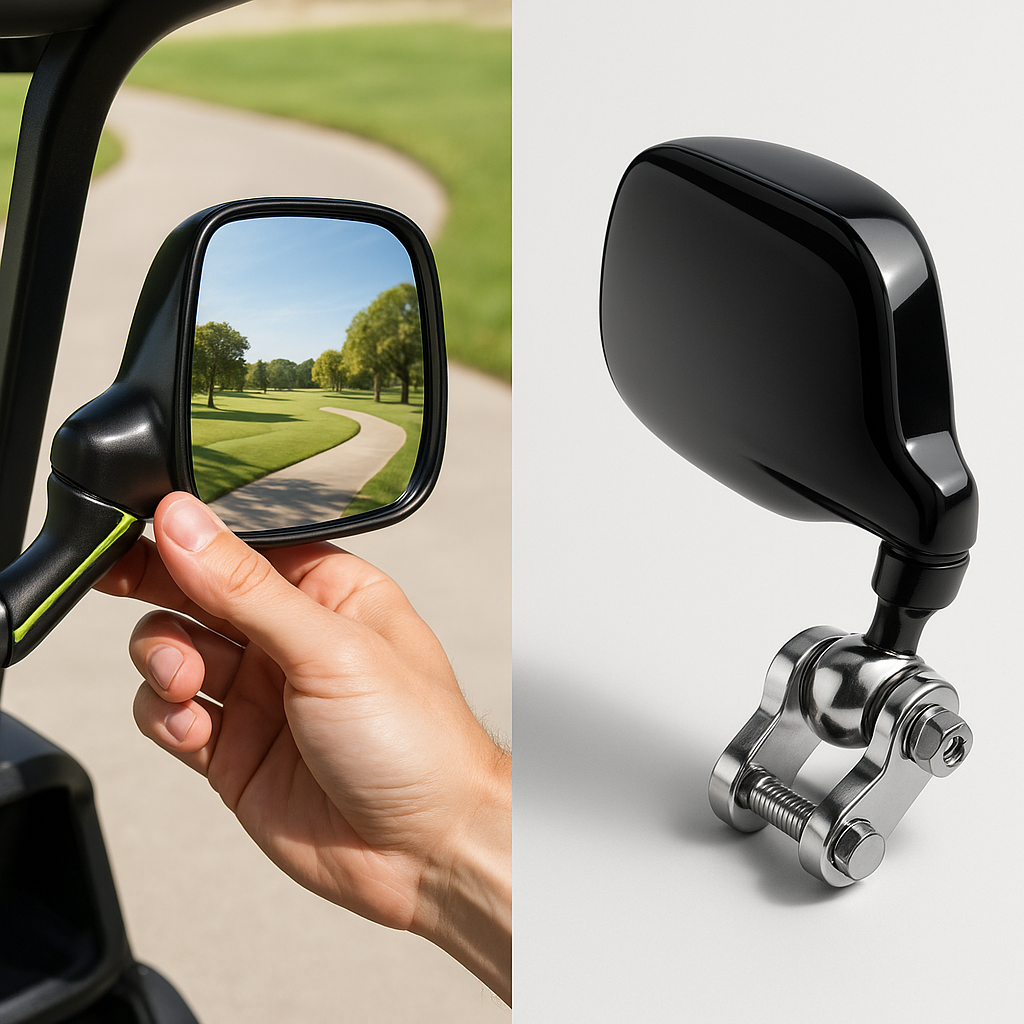
A center rearview mirror — the kind mounted to the roof support or windshield frame — should frame as much of the road or path directly behind you as possible. Tilt it so the bottom edge of the reflected image sits near ground level, not halfway up the scene. You want to see where the cart behind you actually is, not just the tops of obstacles. Adjust the horizontal angle so the image is centered left-to-right relative to your natural line of sight. Most golf cart rearview mirrors use a simple ball-and-socket or pivot joint — loosen the mounting hardware just enough to allow movement, reposition, then snug it back down firmly. Avoid overtightening if the joint is plastic, since cracking the housing will let the mirror drift over time from vibration.
Adjusting Side Mirrors
Side mirrors on a golf cart function a little differently than on a car because the cart is much narrower. The goal is to see the area immediately beside and behind the rear of the cart — the blind zones you genuinely can't see by turning your head while driving. Angle the mirror outward just enough to show the edge of the cart body at the inner margin of the reflection; that reference point helps you judge spacing. Tilt it vertically so you can see the ground plane at a distance of roughly one to two car lengths back. If your mirrors are mounted on a folding or swiveling arm, check that the arm itself is locked at the right angle before fine-tuning the mirror head — adjusting only the mirror head when the arm is off-axis will compound the error.
Check for Vibration Drift
Golf carts travel on uneven terrain — cart paths have expansion joints, turf is bumpy, and street-legal carts hit real pavement irregularities. After your initial adjustment, take the cart for a short drive and check the mirrors again when you return. If either mirror has drifted noticeably, the mounting hardware isn't tight enough, or the joint is worn. Snug up the fasteners incrementally — you want firm resistance, not so much torque that you strip threads or crack the bracket. Some owners use a small amount of threadlocker on metal-to-metal fasteners that keep working loose; this is a reasonable approach for a mirror that won't need frequent repositioning.
Common Adjustment Mistakes to Avoid
The most frequent mistake is angling a rearview mirror too high, which fills the reflection with the underside of the roof rather than the path behind you. The second most common error is positioning side mirrors so they show mostly the side of the cart rather than the space beside and behind it — this is a natural instinct, but it wastes most of your field of view. A third issue is accepting a loose mirror and assuming it's fine because it looks okay at rest. On a moving cart, a loose mirror will vibrate enough to make the image useless, defeating the whole purpose. Take the extra thirty seconds to get every fastener properly tightened.
Special Considerations for Street-Legal Carts
If your golf cart is registered for road use, mirror requirements vary by state and municipality, but the general standard is that you need at least one mirror providing a clear rearward view — many jurisdictions require both a rearview and a driver's-side mirror. Beyond legal compliance, the adjustment principles are the same: you need to actually see what's behind and beside you at real road speeds. At higher speeds, vibration and wind become more significant factors, so secure mounting matters even more. Check your mirror positions any time you've had the cart in for service, installed new accessories that changed the mounting points, or noticed the mirrors have shifted.
Good visibility isn't a luxury on a golf cart — it's a basic safety function. Spend a few minutes getting your mirrors aimed correctly, verify they hold their position after a test drive, and re-check periodically as part of your normal cart maintenance routine. It's one of the simplest things you can do to make every ride safer.