Installing mirrors on your golf cart is only half the job. A mirror that's angled wrong, vibrating loose, or positioned too close to your sightline is almost as useless as no mirror at all. Whether you've just mounted new mirrors or you're troubleshooting a setup that never felt quite right, proper adjustment is a skill worth getting down. It takes five minutes and makes a real difference — especially on roads, cart paths, or crowded communities where you're sharing space with pedestrians and vehicles.
Start With Your Seating Position
Before you touch a mirror, sit in your normal driving position with your hands where they'd naturally rest on the wheel. Don't adjust the mirrors first and then sit down — that's backwards, and it's the most common mistake people make. Your head and eye position while driving is the reference point everything else is built around. If you share the cart with other drivers of different heights, set the mirrors for the most frequent driver and note how much adjustment others will need.
Setting Side Mirrors
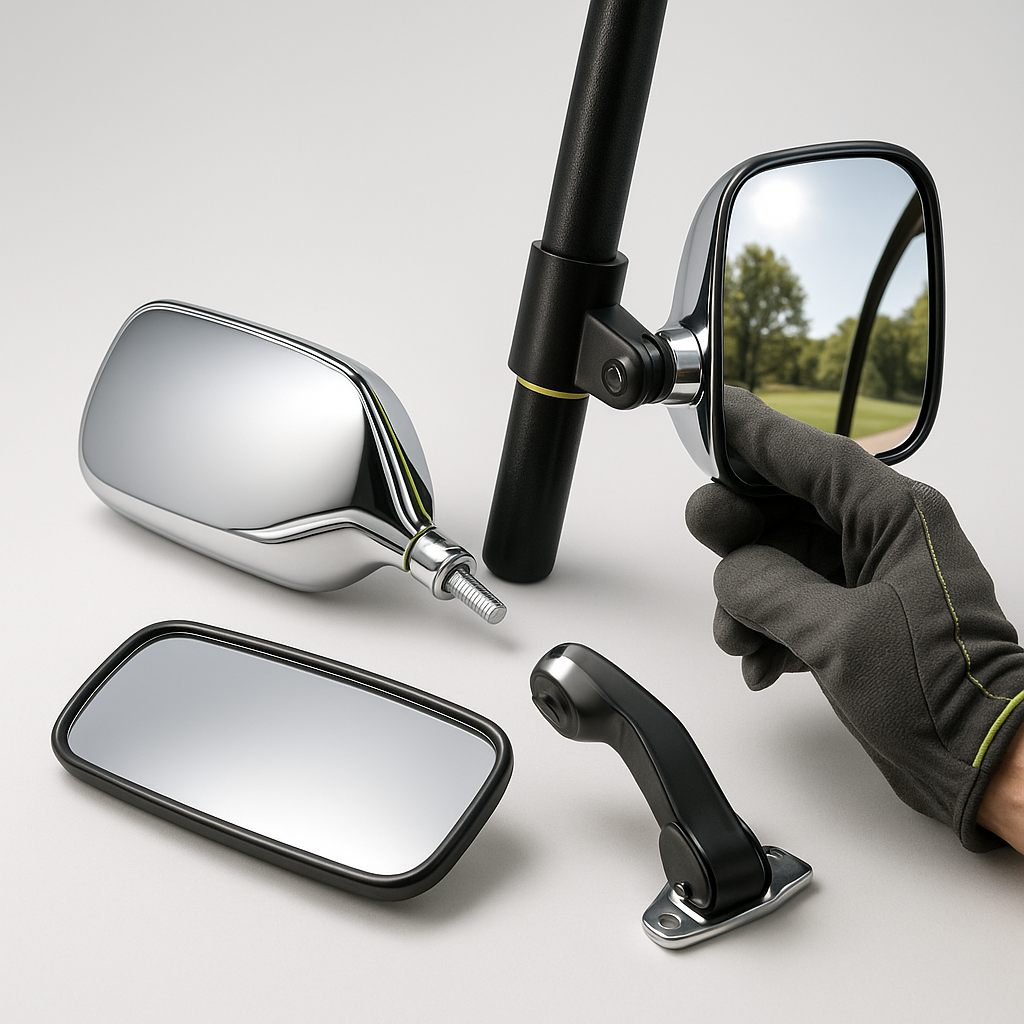
For side mirrors, you want to see a thin sliver of the cart's body along the inner edge of the mirror — just enough to give you a reference point for distance and positioning. The bulk of the mirror's view should be the area beside and behind the cart. Angle the mirror downward just slightly so you can see the ground a reasonable distance back; this is especially useful when reversing near curbs, obstacles, or people. If the mirror is aimed too high, you'll see sky and treetops instead of what's actually happening in your blind zone. Tighten the mounting hardware snugly once you've found the right angle — mirrors that vibrate or drift over bumps are constantly falling out of adjustment and become distracting fast.
Setting a Rear View Mirror
A center rear view mirror should frame the opening behind you — typically the space between the rear uprights or through the back of the canopy. Adjust the angle so the horizon sits roughly in the middle of the mirror's reflection when you're sitting upright. If you tilt it too far down, you see the rear seat or cargo area. Too far up, and you're looking at the top of the windshield frame. The goal is a wide, centered view of the path directly behind the cart. On carts with rear-facing back seats or cargo beds, a wider convex mirror often works better than a flat mirror, since the flat mirror's view may be partially blocked by passengers or cargo.
Check Your Blind Spots
Once both side mirrors and your rear view mirror are set, do a practical check before you drive. Have someone walk slowly along each side and behind the cart while you watch in the mirrors. You should be able to track them continuously without losing them between the side mirror and your peripheral vision for longer than a step or two. If there's a large gap — a zone where they disappear entirely — adjust the relevant mirror outward slightly. No mirror setup eliminates all blind spots on a golf cart, but you can minimize them significantly with careful positioning.
Dealing With Vibration and Mirror Drift
Golf carts are low-speed vehicles, but cart paths and turf can be surprisingly rough. Mirrors mounted on thin uprights or folding canopy frames tend to vibrate more than those clamped to solid structural tubing. If your mirrors won't stay put despite tightening the hardware, check whether the mount itself is the issue — a worn or undersized clamp on an oversized tube won't hold no matter how hard you tighten the bolt. Some mounts include rubber inserts or shims that help fill gaps and dampen vibration; if yours didn't come with them, a strip of rubber tape around the mounting tube can make a meaningful difference. Never over-tighten aluminum mirror arms to compensate for a poor fit — you risk cracking the arm or stripping the threads.
Re-Check After the First Few Rides
Even a properly adjusted and tightened mirror will sometimes shift slightly after the first few rides as everything settles. Make it a habit to glance at your mirrors before you pull away and confirm they're still where you set them. A thirty-second check every few uses will catch any drift early, before it becomes a safety issue. If a mirror is consistently drifting back to the same wrong position, that's a signal the mount needs attention — not just another tightening.
Visibility is one of the simplest and most overlooked safety upgrades on a golf cart. Mirrors you've actually dialed in correctly — not just bolted on and forgotten — give you the situational awareness to drive confidently around other people, vehicles, and tight spaces. Take the few minutes to do the adjustment properly, and you'll notice the difference every time you back up or change direction.