Installing a lift kit is one of the most impactful modifications you can make to a golf cart — more ground clearance, bigger tires, a more aggressive stance. But a lift also changes the geometry of every system underneath the cart: suspension angles, spindle positions, camber, toe, and the relationship between steering components. When something feels off after a lift — pulling to one side, shimmy at speed, a vague or darty steering feel, or a cart that seems to want to tip in turns — you're usually dealing with one of a handful of very specific problems introduced by the lift itself, not a random failure. This guide walks you through how to diagnose each one systematically.
Start With a Visual Inspection Before You Drive
Before you put the cart back in service after a lift, or if problems showed up shortly after installation, get underneath it with good lighting and inspect everything while it's stationary. Check that all mounting hardware is fully tightened — lift blocks, A-arm extensions, spindle brackets, and any drop-spindle hardware. Loose or undertightened fasteners are among the most common causes of handling problems after a lift, and they're dangerous. Look at each wheel and eyeball the camber angle (the tilt of the wheel relative to vertical). A small amount of positive or negative camber is often unavoidable with certain lift designs, but a wheel that looks dramatically tilted inward or outward at the top is a problem. Also look at toe — if the fronts of the tires are noticeably pointing in or out relative to each other, the toe needs adjustment before the cart should be driven.
Check Wheel Alignment and Toe First
Toe is the most common geometry problem after a lift and one of the easiest to measure. With the cart on flat ground and the steering wheel centered, crouch down in front and sight along the leading edges of both front tires. They should be parallel or very slightly toed in — the exact spec varies by cart model, but anything more than a very small difference is enough to cause pulling, tire scrub, and instability. If the cart pulls to one side while driving, check tire pressures first (unequal pressure mimics an alignment pull), then check whether the front tires are sitting at the same height and angle. Toe adjustments are made at the tie rod ends on most carts — loosen the jam nut and turn the tie rod to lengthen or shorten it. If you're not comfortable doing this yourself, a shop with an alignment rack is worth the trip.
Evaluate Steering Geometry Changes
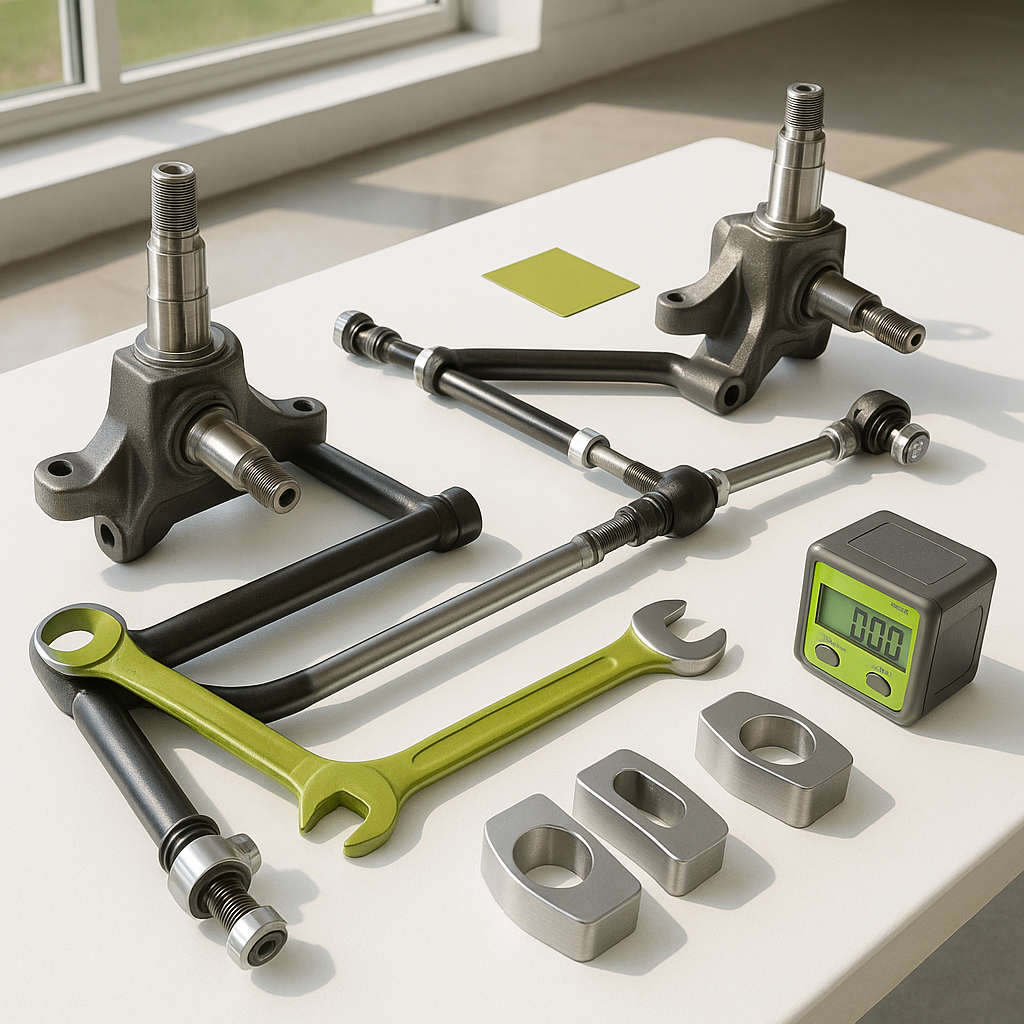
Lift kits — especially spindle-based designs — can alter the steering axis inclination and the way the tie rods connect to the spindle. If the tie rods end up running at a steeper or shallower angle than they were designed for, you can introduce bump steer: a condition where the steering jerks or changes direction on its own as the suspension compresses and rebounds over bumps. To check for this, push down on one front corner of the cart while watching the steering wheel. If the wheel turns noticeably when you compress the suspension, bump steer is likely present. Some lift kits include corrected tie rod or steering arm geometry to address this; others require aftermarket correction hardware. It's worth confirming your lift kit is designed for your specific cart model, because a generic or mismatched kit is more likely to introduce these angles.
Look at Ball Joints, Tie Rod Ends, and Pivot Points
A lift puts new stress on steering and suspension joints, and it also changes the angles those joints operate through. Worn or marginal ball joints or tie rod ends that were holding up fine before a lift can start to show play once the geometry changes. Grab each front wheel with both hands — one at the top, one at the bottom — and try to rock it. Any detectable play in that axis points to a worn ball joint or kingpin. Now grab the wheel at the 3 and 9 o'clock positions and try the same thing; play here usually points to tie rod ends or steering components. These joints should be inspected any time you change suspension geometry, and replaced if there's any perceptible looseness.
Check the Tires and Wheels Themselves
Bigger tires are almost always part of a lift kit upgrade, and they introduce their own set of potential problems. An out-of-balance tire causes shimmy or vibration that gets worse at higher speeds — have the tires balanced if you haven't already, especially if the cart is used on hard surfaces or roads. Check that the wheels are properly seated on the hubs and that all lug nuts are torqued evenly. Also look for any rubbing — rotate each tire by hand and watch for contact with fender wells, frame rails, lift brackets, or brake cables. Rubbing that only happens under load or when turning is harder to spot statically, so also walk alongside the cart at low speed and listen for intermittent scrubbing sounds.
Assess Stability in Turns
A lifted cart has a higher center of gravity, which is a real physics tradeoff, not just a warning label issue. If the cart feels like it wants to lean excessively in turns or feels unstable when one side hits a bump, that's largely a function of the lift height, tire width, and how the weight is distributed. Wider tires (especially when paired with wheel spacers) improve stability; narrower tires on a tall lift are the worst combination. If stability in turns is the concern, check whether the cart is carrying heavy loads mounted high (rear seat kits, cargo, batteries in non-stock positions) and whether the tires are as wide as practical for the application. Some lift heights genuinely call for wider rubber to stay safe, and no amount of alignment work will fully compensate for a center of gravity that's simply too high for a given tire width.
When to Get Professional Eyes on It
Some handling problems after a lift are straightforward DIY fixes — loose hardware, a toe adjustment, a tire balance. Others, like persistent bump steer, incorrect spindle geometry, or a frame that shifted during installation, need more diagnostic work than most home mechanics can do safely. If you've worked through the checks above and the cart still pulls, shimmies, or feels unstable, take it to a shop familiar with lifted golf carts before putting it back in regular use. A cart with compromised handling at even low speeds is a real safety hazard, and the cost of a professional inspection is trivial compared to the cost of getting it wrong.