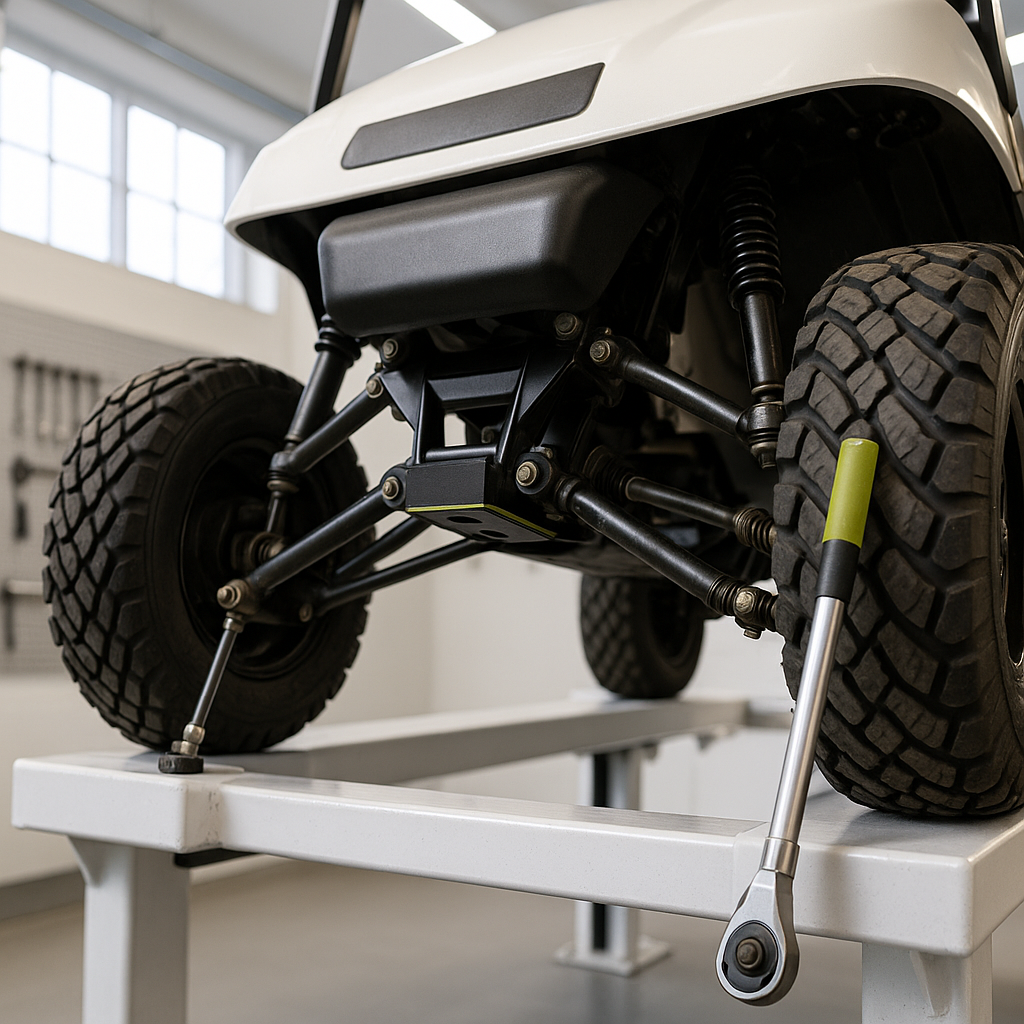
Installing a lift kit is one of the most satisfying upgrades you can make to a golf cart — more clearance, bigger tires, a more aggressive stance. But it also shifts the geometry of your entire suspension and steering system. When handling goes wrong after a lift, the cause isn't always obvious, and blaming the lift kit itself is usually too simple. Most handling issues after a lift are the result of components that weren't adjusted, torqued, or replaced to account for the new geometry. Working through this systematically will get you to the actual culprit.
Wander, Pulling, or Vague Steering
If your cart now wanders or pulls to one side, the first thing to check is toe alignment. Lifting a cart — especially with a spindle-style lift — changes the angle of the front suspension components, which almost always throws off toe. Even a small amount of toe-out will make the cart feel like it's constantly fighting you. You don't need specialized equipment to do a basic toe check: measure the distance between the front edges of both front tires at axle height, then measure the rear edges. Those numbers should be close to equal or very slightly toe-in depending on your cart model. If they're noticeably different, your tie rods need to be adjusted. Don't assume the installer set this correctly — toe should always be verified after a lift, especially if you also went to a wider or larger tire.
Vibration or Shimmy at Speed
Vibration that wasn't there before the lift is almost always a wheel and tire issue, but the lift changes the context. Larger tires fitted after a lift are much more sensitive to being out of balance than the stock tires were. If the tires weren't balanced after mounting, get that done first — it's the most common cause of shimmy and the cheapest fix. After that, check that all lug nuts are torqued evenly and that none of the new lift components have any loose fasteners. On lifted carts with added spindle height or A-arm kits, also inspect the tie rod ends and ball joints. These are under more stress at the new geometry angles, and any play that was borderline before the lift may now show up as noticeable vibration.
Bumpiness or Harsh Ride
A lifted cart on larger tires can actually ride smoother — but only if the tire pressure is correct. Larger tires are often run at the same pressure as the stock tires, which is usually wrong. Check the manufacturer's recommendation for your specific tire size; in many cases, a modest reduction in pressure dramatically smooths out the ride. If pressure isn't the issue, look at whether the lift kit included new or stiffer leaf springs or shock mounts. Some lift kits increase ground clearance primarily by stiffening the suspension rather than adding true travel, which trades ride quality for height. That's a design tradeoff, not a defect — but it's worth understanding what your specific kit does.
Steering That Feels Heavy or Binds
If steering effort increased noticeably after the lift, check the steering shaft and any coupler connections first. Some lift installations require dropping the front end enough that the steering shaft coupler is disturbed or the column angle changes slightly. Inspect for binding at full lock in both directions. Also check that the tie rods aren't contacting any part of the lift brackets at steering extremes — this is a real safety concern, not just a comfort issue. Lubricate the king pins and spindle bushings if your cart uses them; they're often disturbed during installation and benefit from fresh grease.
Cart Feels Tippy or Top-Heavy in Turns
Raising the center of gravity is a physical reality of lifting any vehicle, and golf carts have a narrower track than most vehicles to begin with. If the cart feels like it wants to lean aggressively in turns, the most practical solution is wider tires and, if your lift kit supports it, wheel spacers to widen the stance. This genuinely improves stability rather than just making the cart look more aggressive. More importantly, if the cart feels dangerously unstable, slow down on turns — this isn't a break-in issue that goes away. Lifted carts should be driven with the understanding that rollover threshold is lower than stock. If instability is severe, confirm that the lift kit you installed is actually rated for your cart model and year, since an incorrectly sized kit can create geometry that no amount of adjustment will fully correct.
Noise From the Front End
Clunking or knocking from the front suspension after a lift usually points to loose hardware. Go through every bolt on the lift kit — control arms, spindle bolts, tie rod ends — and verify they're properly torqued. New hardware can settle and loosen after the first several hours of use, so a re-torque check at around 50 miles is a good habit after any suspension installation. If the noise persists after tightening everything, check for contact between the lift components and the frame or body at full suspension travel. A zip tie rubbing on a fender sounds alarming but is trivial to fix; a lift bracket bottoming out on the frame is not.
When to Get a Second Set of Eyes
Lift kit installations touch steering geometry, suspension travel, and sometimes brake line routing — all systems where a mistake has real safety consequences. If you've worked through the checks above and still can't isolate the problem, or if anything about the handling feels genuinely unsafe rather than just annoying, bring it to a golf cart shop or a mechanic comfortable with small utility vehicles. A short alignment check and a fresh set of eyes on the install are worth the cost if you're not fully confident in what you're seeing.