A lift kit is one of the most popular modifications on any golf cart — more ground clearance, bigger tires, a more aggressive stance. But when something goes wrong after a lift, the symptoms can be confusing. The cart might shimmy at speed, pull to one side, wear tires unevenly, or feel like it's rolling on square wheels. Before you assume you got a bad kit or the wrong parts, walk through this diagnostic process. Most lift-related handling problems have a small number of root causes, and most of them are fixable without replacing major components.
Start With the Obvious: Installation Checks
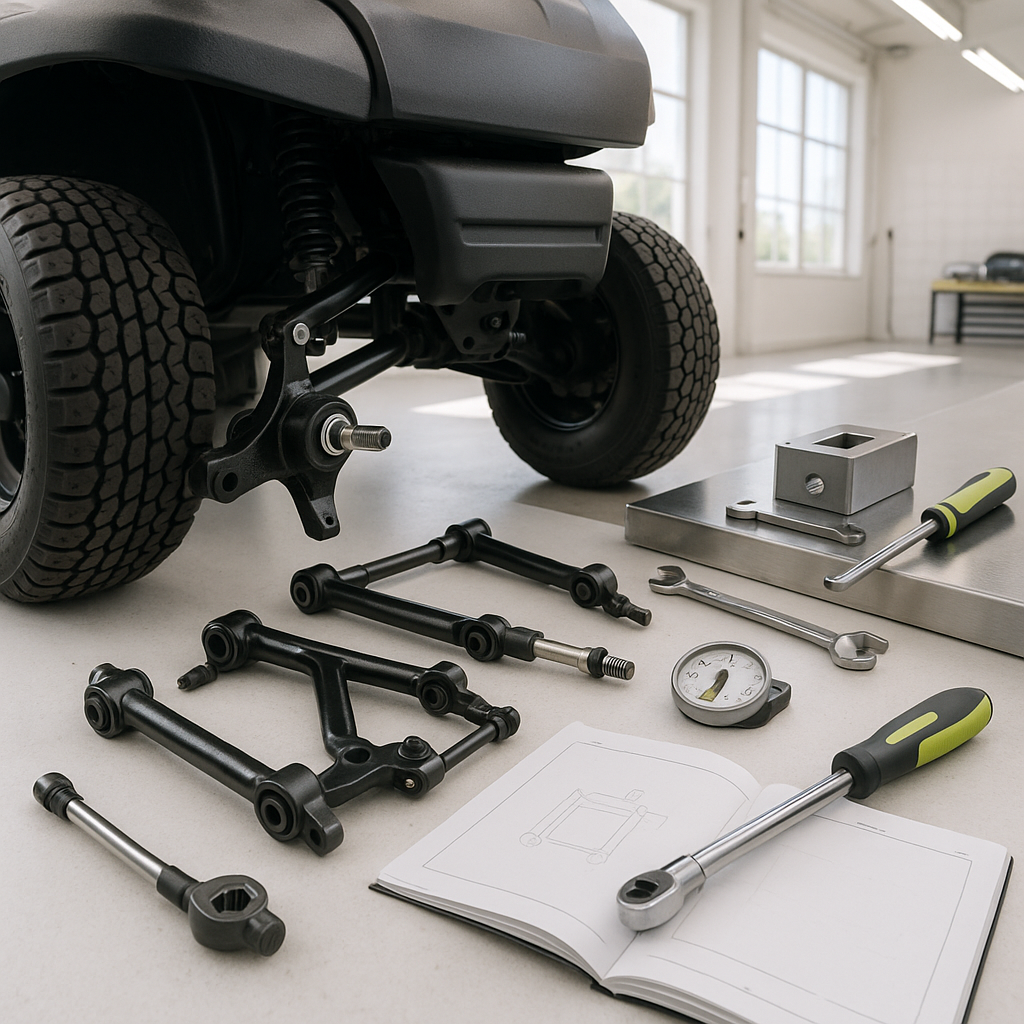
The most common source of post-lift handling problems is an installation issue, not a parts failure. Check that every fastener is properly torqued — loose spindle bolts, A-arm hardware, or leaf spring U-bolts can all cause shimmy, wandering, or clunking. Get the cart on a flat surface, grab each front wheel at the 9 and 3 o'clock positions, and try to wiggle it. Any play you feel could indicate a loose tie rod end, a worn ball joint, or hardware that wasn't fully tightened during install. Then do the same at 12 and 6 o'clock to check for wheel bearing play. These checks take five minutes and catch the majority of problems.
Tire and Wheel Fitment Problems
A lift kit is almost always paired with larger tires, and the combination needs to be dialed in correctly. If your new tires are rubbing against the fender, body, or frame at full steering lock, that's a fitment mismatch — you may need to trim the fender, run a wheel spacer, or reconsider the tire size. Rubbing that only happens over bumps indicates insufficient clearance in the suspension travel arc, not just at static ride height. Also inspect your new tires for any out-of-round condition; an aggressive off-road tread on a cart that isn't perfectly balanced will amplify every vibration, especially at higher speeds. If the cart shakes in a narrow speed range and smooths out above it, wheel balance is the first thing to address.
Alignment and Toe Settings
Any time you change the suspension geometry on a golf cart — which a lift kit absolutely does — you've changed the toe, camber, and caster angles. Even if everything was aligned perfectly before the lift, it won't be after. Improper toe is the most common culprit for tire wear and wandering: too much toe-in or toe-out will scrub the front tires and make the cart feel like it wants to dart in one direction. Fortunately, front toe on most golf carts is adjustable via the tie rod ends and is something you can set at home with a tape measure and some patience. Measure the distance between the front edges of both front tires, then the rear edges, at hub height. Most golf carts run a very slight toe-in. If those numbers are significantly off after your lift, adjust accordingly before condemning any parts.
Camber and Caster: Understanding What You Can't Always Fix
Lift kits change camber (the lean of the tire relative to vertical) and caster (the forward or backward tilt of the steering axis) in ways that vary by kit design. Spindle-style lifts typically maintain better geometry than simple block or spacer lifts, which is one reason spindle kits cost more. If your lifted cart has noticeable positive camber — tires visibly tilting outward at the top — that's a geometry issue inherent to the lift design, and it will cause accelerated tire wear on the outer edges. Some aftermarket A-arm kits correct this. If you're running a basic block lift and experiencing severe handling issues, the geometry compromise may simply be the tradeoff for that style of installation. Understanding that upfront helps you decide whether a geometry-correcting spindle kit is worth the upgrade.
Steering and Suspension Component Wear
Lifting a golf cart puts more stress on steering and suspension components than stock geometry does. Tie rod ends, ball joints, and bushings all work through a greater range of motion and at different angles than they were originally designed for. If your cart has any pre-existing wear in these components, a lift will make it dramatically worse. Grab each tie rod end and check for any looseness or binding. Inspect ball joints for play. Check any rubber bushings in the A-arms or leaf spring mounts — cracked or collapsed bushings are a very common source of clunking and vague steering that gets blamed on the lift kit but is really just accelerated wear on parts that were already marginal.
Rear Lift Issues: Block Lifts and Axle Angles
On the rear of the cart, most lift kits use either a block lift (raising the axle housing relative to the leaf springs) or extended shackles. Block lifts are simple and inexpensive but they do increase the pinion angle on rear-axle carts, which can cause vibration or drivetrain noise, particularly under load. If you're hearing a new vibration from the rear that gets worse when accelerating or going uphill, the axle angle is worth investigating. Extended shackle lifts change the spring rate and travel characteristics, which can make the rear feel bouncy or harsh depending on the spring condition. If your rear springs are old, a lift is a good time to inspect them and replace if they're sagging or cracked.
When to Reassess the Kit Itself
If you've worked through all of the above and the handling still isn't right, it's worth honestly evaluating whether the kit was the right match for your specific cart model and year. Lift kits are model-specific for a reason — the geometry corrections, bracket mounting points, and spindle dimensions are all designed around a particular chassis. A kit installed on the wrong model year, or a universal-fit kit forced onto a cart it wasn't designed for, will produce persistent handling problems that no amount of adjustment will fully correct. Cross-reference your cart's model and year against the kit's fitment specifications carefully. If there's any doubt, connecting with a golf cart shop that can physically inspect the setup is the most reliable path forward.