A mirror that technically stays mounted but still gives you a terrible view is almost as useless as no mirror at all. Poor visibility from a golf cart mirror is one of those problems that's easy to dismiss — until you nearly back into a fence post, a pet, or another cart. The good news is that most visibility problems come down to a handful of fixable causes, and you don't need special tools to work through them.
Start With the Obvious: Angle and Position
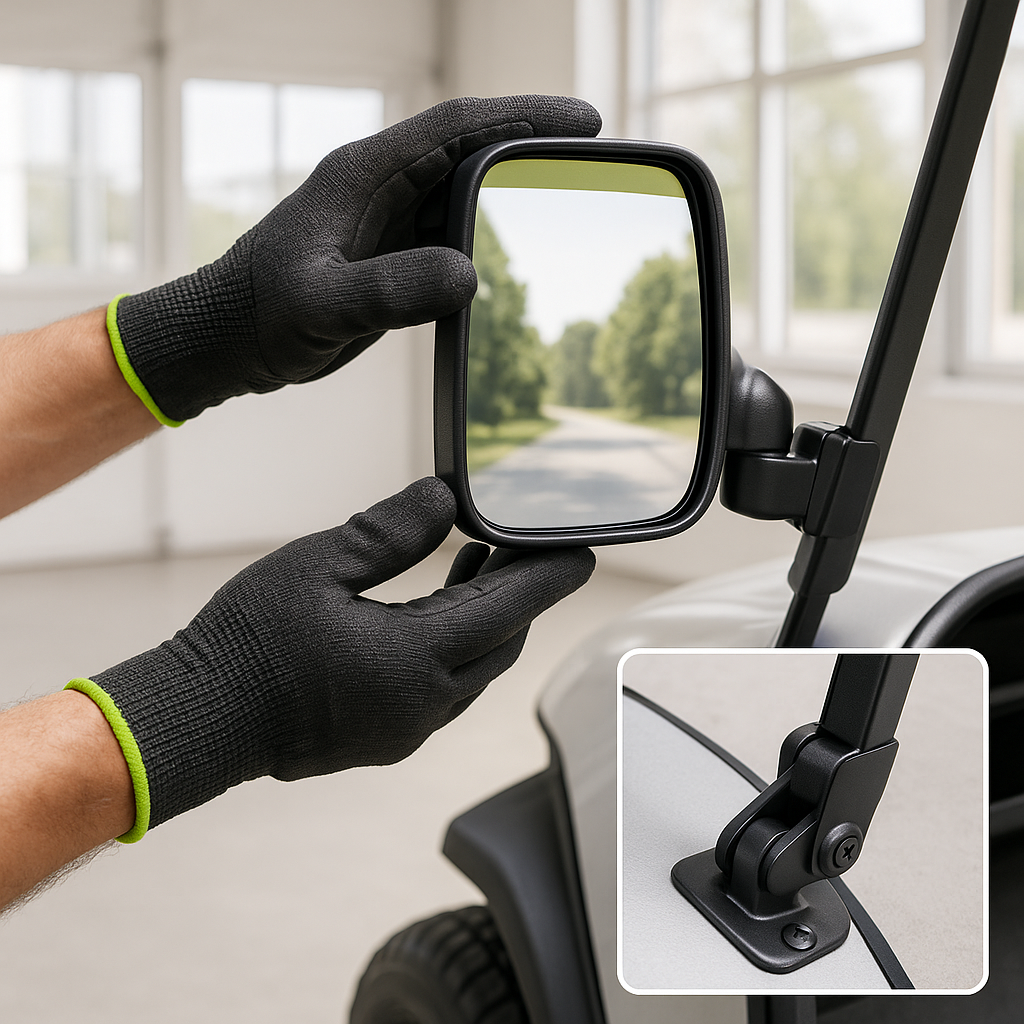
The most common reason a mirror doesn't show you what you need to see is simply that it was never adjusted correctly — or it drifted over time. Before assuming there's a deeper problem, sit in your normal driving position and look at what the mirror actually reflects. A rearview mirror should show you a clear horizontal band directly behind the cart. Side mirrors should show you the rear quarter and anything approaching from beside or behind. If the angle is off — pointing at the sky, the roof, or the ground — the mirror mount has either loosened or was set wrong from the start. Loosen the adjustment joint just enough to reposition the mirror, then tighten it back down firmly. If the joint won't hold position and keeps drifting, the friction mechanism inside is worn and the mirror assembly likely needs to be replaced.
Check for Mirror Surface Damage
Older mirrors — especially those that have lived through years of UV exposure, rain, and cleaning with harsh chemicals — can develop a degraded reflective coating. Signs include a dull or yellowish tint, small dark spots at the edges, a streaky appearance that won't clean off, or a wavy distortion that makes it hard to judge distances. None of these issues can be fixed by cleaning. If the mirror glass itself is deteriorated, the only real solution is replacing the mirror head. This is typically inexpensive and straightforward on most aftermarket mirror setups.
Dealing With Glare
Glare is most noticeable when driving toward the sun in the early morning or late afternoon, or when headlights from behind wash out your view at night. A few things make glare worse: a mirror surface angled slightly upward instead of level, a highly polished chrome mirror housing that bounces light into your eyes, or a mirror positioned right in your sightline to the sun. Adjusting the vertical tilt of the mirror even a few degrees downward often makes a significant difference. Some replacement mirrors are designed with an anti-glare or day/night adjustment feature that lets you flip the mirror to a dimmer reflective surface for night driving — worth considering if nighttime glare is a recurring problem on your cart.
Vibration Blur
If your mirror is clear when the cart is stopped but becomes a blurry smear once you're moving, the issue is vibration. This is extremely common on golf carts because they run on relatively stiff suspensions and often cover rough terrain. The mirror mount may be loose, the mounting surface itself (a grab bar, windshield frame, or roof support) may flex at speed, or the mirror arm may simply be too long and too lightweight to stay rigid under vibration. Start by tightening every connection point in the mirror assembly. If the problem continues, check whether the mounting surface itself is flexing — if you can see the whole mounting point moving, no amount of tightening the mirror will help. In that case, relocating the mirror to a more rigid attachment point is the fix.
Obstruction You Didn't Notice
Sometimes the view problem isn't the mirror at all — it's something blocking the line of sight between the mirror and what's behind you. A rear enclosure panel, a cooler or bag mounted in the rear, a folded-down rear seat, or even a lifted roof that changed your sightlines can all create blind spots that feel like a mirror problem. Walk around to the rear of your cart and look forward — consider what the mirror can actually see from its mounted position. Repositioning cargo, adjusting the mirror height, or adding a second mirror on the opposite side are all practical solutions depending on what's causing the obstruction.
When to Add a Mirror Instead of Just Adjusting One
A single center rearview mirror has real limitations on a golf cart — it can only show you what's directly behind, and your sightlines are often more restricted than in a car. If you've corrected position, vibration, and surface issues but still feel like your visibility is inadequate, the honest fix may be to add side mirrors rather than keep fighting the geometry of one mirror. Side mirrors give you coverage that a single rearview mirror simply can't provide, and for carts used on roads or in higher-traffic situations, the added visibility is genuinely worth it.