A golf cart mirror that vibrates into uselessness or refuses to hold its adjustment isn't just annoying — it's a genuine safety problem, especially if you're driving on shared paths, roads, or a busy course. The good news is that most mirror issues come down to a small set of root causes, and almost all of them are fixable without special tools or professional help. Before you replace anything, work through these checks systematically.
Start With the Mount — It's the Most Common Culprit
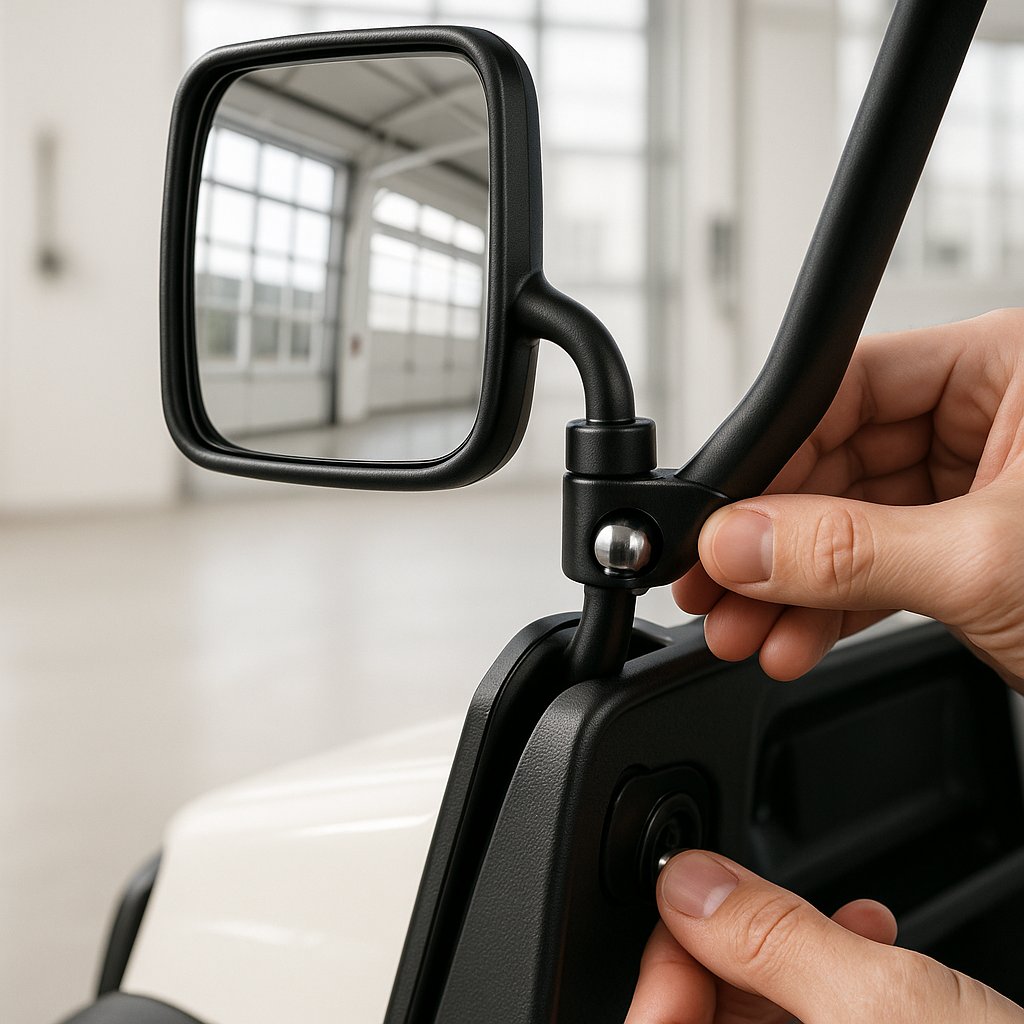
The majority of mirror problems trace back to how the mirror is mounted, not to the mirror itself. Golf carts vibrate more than most people expect — the combination of rough terrain, plastic body panels, and a relatively rigid frame means vibration travels everywhere. If the mounting clamp or bracket has any play in it, that play will multiply as the mirror arm extends outward. Check that the mounting hardware is fully tight against whatever surface it's clamped to — windshield frame, roof support strut, or body panel — and make sure there's no movement at the base before you look anywhere else. A clamp that feels snug by hand may still have enough looseness to cause problems at speed.
Check the Mirror Arm and Pivot Joint
After the mount, the next place to look is the pivot point where the mirror head connects to the arm, and where the arm connects to the base. These joints need to be tight enough to hold a set position against wind resistance and vibration, but on older or well-used mirrors they often loosen up over time. Tighten any visible fasteners at the pivot. If the joint uses a friction-based design rather than a threaded fastener, it may simply be worn out — the friction surface has degraded and no longer holds. In that case, replacement is usually the right call rather than trying to shim or glue the joint.
Identify Whether It's Vibration or Looseness (They Feel Different)
It helps to distinguish between two different failure modes. True vibration means the mirror buzzes or shakes while you're moving but holds its position when stopped — this points to resonance, meaning the mirror arm is acting like a tuning fork at certain speeds. Looseness means the mirror drifts or gets knocked out of position and stays there. For resonance-type vibration, a shorter arm, a more rigid mounting surface, or adding a small amount of rubber damping material between the clamp and the mounting surface can help significantly. For looseness, the fix is always tightening or replacing the loose joint.
Inspect the Mounting Surface Itself
Sometimes the mirror hardware is fine but the surface it's mounted to is the problem. Plastic windshield frames can flex, thin body panels can bow, and roof struts on aftermarket tops may not be as rigid as OEM metal framing. If your mirror is clamped to something that moves, the mirror will move. Consider whether you can relocate the mount to a more solid surface, or whether adding a backing plate behind a thin panel would help distribute the clamping force and reduce flex.
Universal Fit Mirrors: Extra Considerations
Universal mirrors are designed to fit a wide range of carts, which means the mounting hardware has to accommodate a lot of variation. This is convenient, but it also means the clamp may not make perfect contact with your specific tubing diameter or frame profile. Gaps in the clamp-to-surface contact are a direct path to vibration. If you're running a universal mount, check that the clamp is actually making full contact around the tube or edge it's grabbing. In some cases, wrapping the mounting point with a thin layer of rubber tape before clamping down can take up that gap and dramatically improve stability.
When to Replace vs. Adjust
If you've tightened everything, confirmed the mounting surface is solid, and the mirror still won't hold adjustment or still vibrates badly, the pivot mechanism is likely worn beyond what adjustment can fix. Mirrors are relatively inexpensive components and the hardware degrades with UV exposure, repeated adjustment, and vibration over time. A worn pivot that no longer holds friction isn't going to get better — replacement is the right move. When shopping for a replacement, pay attention to the arm length and mount type relative to where you plan to install it: a shorter, more rigid arm on a solid mounting point will almost always outperform a long arm on a flexible surface, regardless of mirror quality.