A golf cart mirror that vibrates into uselessness at 10 mph, droops out of position after every bump, or gives you a perfect view of your own elbow isn't just annoying — it's a real safety hazard, especially if you're running your cart on public paths, campgrounds, or low-speed roads. The good news is that most golf cart mirror problems come down to a short list of causes, and diagnosing them is straightforward if you know what to look for.
The Mirror Vibrates or Shakes While Driving
Vibration is the most common complaint with golf cart mirrors, and it almost always points to one of two problems: a loose mounting connection or a mirror arm that's too long and unsupported for the amount of road vibration your cart generates. Start at the mounting point — whether your mirror attaches to the roof strut, windshield frame, or a grab bar, check every fastener in the chain. A single loose bolt or a clamp that's lost its grip will let the mirror oscillate at speed. Tighten everything and test again. If vibration persists even with snug hardware, the problem may be the mount location itself — a long, cantilevered arm attached to a thin or hollow strut has little to dampen movement. In that case, adding a secondary support brace or relocating the mount to a more rigid surface often solves the problem completely.
The Mirror Won't Stay in the Adjusted Position
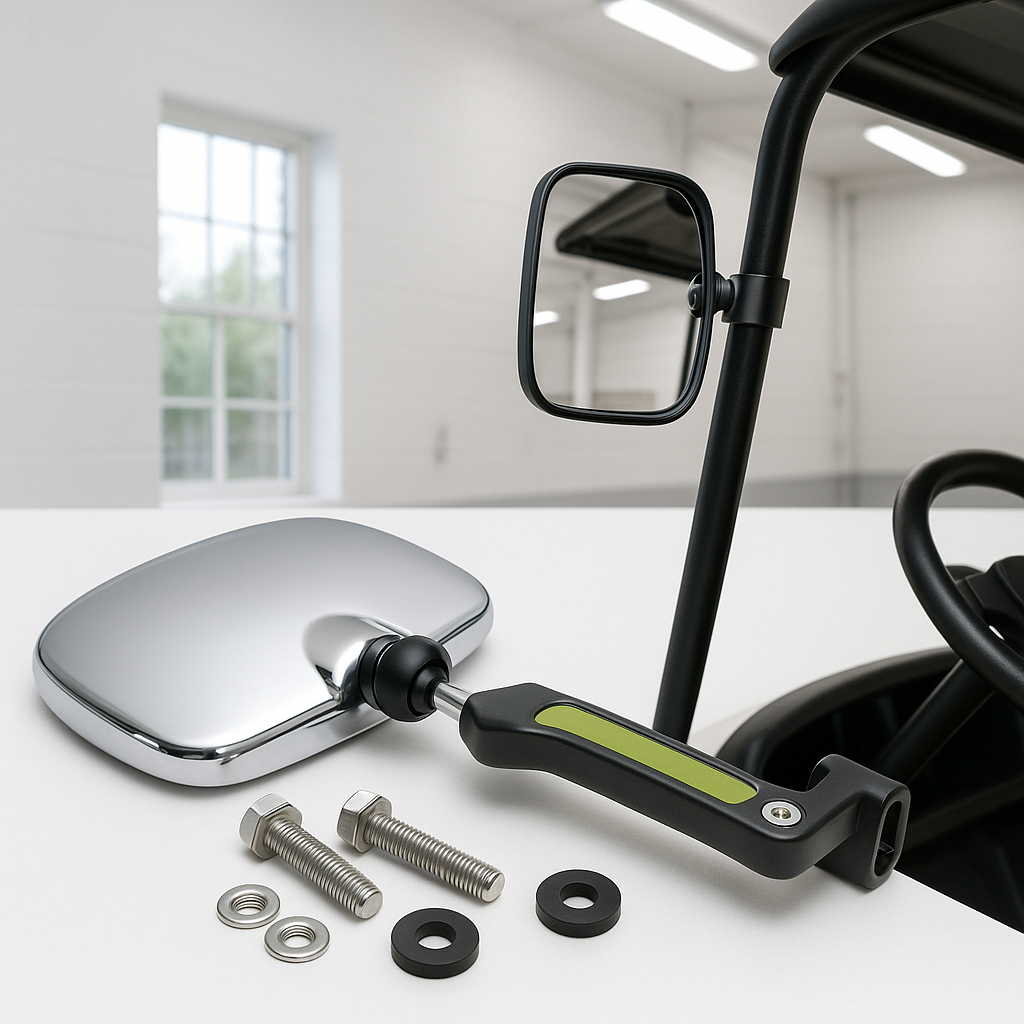
If your mirror holds its position when you set it in the driveway but drifts out of alignment after a few minutes of driving, the pivot joint is worn or under-tensioned. Most mirror arms use either a friction ball joint or a hinged pivot with a tension screw. On ball-joint designs, the socket wears over time and loses grip — sometimes you can disassemble the joint, clean it, and add a thin rubber shim to restore friction. On tension-screw designs, simply tightening the adjuster screw is usually all it takes. If the joint is cracked, stripped, or corroded beyond adjustment, replacement is the right call. A mirror that won't hold its angle is functionally useless and shouldn't be left as-is.
The Mounting Hardware Is Stripping or Won't Tighten
Golf carts see moisture, UV exposure, and constant vibration — a combination that's hard on fasteners. If a bolt or clamp screw turns freely without actually tightening, the threads are likely stripped, either in the bolt itself or in the receiving surface. Don't keep cranking — you'll make it worse. For stripped bolt threads, replace the bolt. For a stripped hole in a clamp body, a thread repair insert (a helicoil-type repair) or a slightly larger replacement fastener often saves the clamp. If the clamp is cheap stamped metal that's cracked or deformed, replace it entirely. Using stainless steel hardware on any outdoor cart application will significantly extend the life of the repair.
Poor Visibility Even With the Mirror Properly Mounted
Sometimes the mirror itself isn't broken — it's just wrong for the application. A mirror mounted too low catches your roof instead of the area behind the cart. One mounted too close to center gives a narrow field of view. Flat mirrors show less than convex mirrors of the same size, but convex mirrors distort distance. Think about what you actually need to see: are you checking for cart traffic behind you on a path, monitoring a trailer hitch, or watching for pedestrians at the edge of your field of view? A single center-mounted rearview mirror works well for straight-back visibility; side-mounted mirrors help with width awareness and reversing. If your current setup has the right hardware but the wrong geometry, sometimes repositioning the mount a few inches makes a dramatic difference before you buy anything new.
The Mirror Arm or Bracket Is Bent or Broken
Mirror arms take abuse — they get bumped in tight parking situations, snagged on low branches, and occasionally used as a handhold by passengers who shouldn't be grabbing them. A bent arm is worth attempting to straighten only if it's solid steel and the bend is minor; aluminum arms that have bent once will often crack if you try to reform them. A cracked weld or a bracket that's broken at the clamp is a safety issue and should be replaced rather than improvised around. When sourcing a replacement arm, pay attention to the clamp diameter — golf cart roll bars and struts come in different tube sizes, and a clamp that doesn't match your cart's tubing will never grip properly regardless of how tight you run the hardware.
When to Replace vs. Repair
The honest answer is that golf cart mirrors are not expensive, and there's a point where chasing a repair costs more time and effort than a replacement is worth — especially if the mirror glass is cracked, the housing is UV-degraded and brittle, or the pivot joint is fundamentally worn out. That said, many mirror problems genuinely are just loose hardware, and a five-minute check with a wrench solves them completely. Work through the basics first: tighten all fasteners, check the pivot tension, verify the mount location is on a rigid surface, and confirm the mirror is sized and positioned appropriately for what you're trying to see. If you've addressed all of those and the mirror still isn't performing safely and reliably, it's time for a replacement.