A golf cart mirror that looks fine at a standstill but vibrates into uselessness once you're moving is one of those problems that's easy to dismiss — until you need to check traffic at a road crossing or back up on a hill. Unlike a mirror that simply won't stay adjusted, vibration blur is a different problem with different causes. It usually means something is loose or resonating in the mounting path between the mirror and the cart frame, and the fix depends on where in that chain the problem lives.
Start With the Mount, Not the Mirror
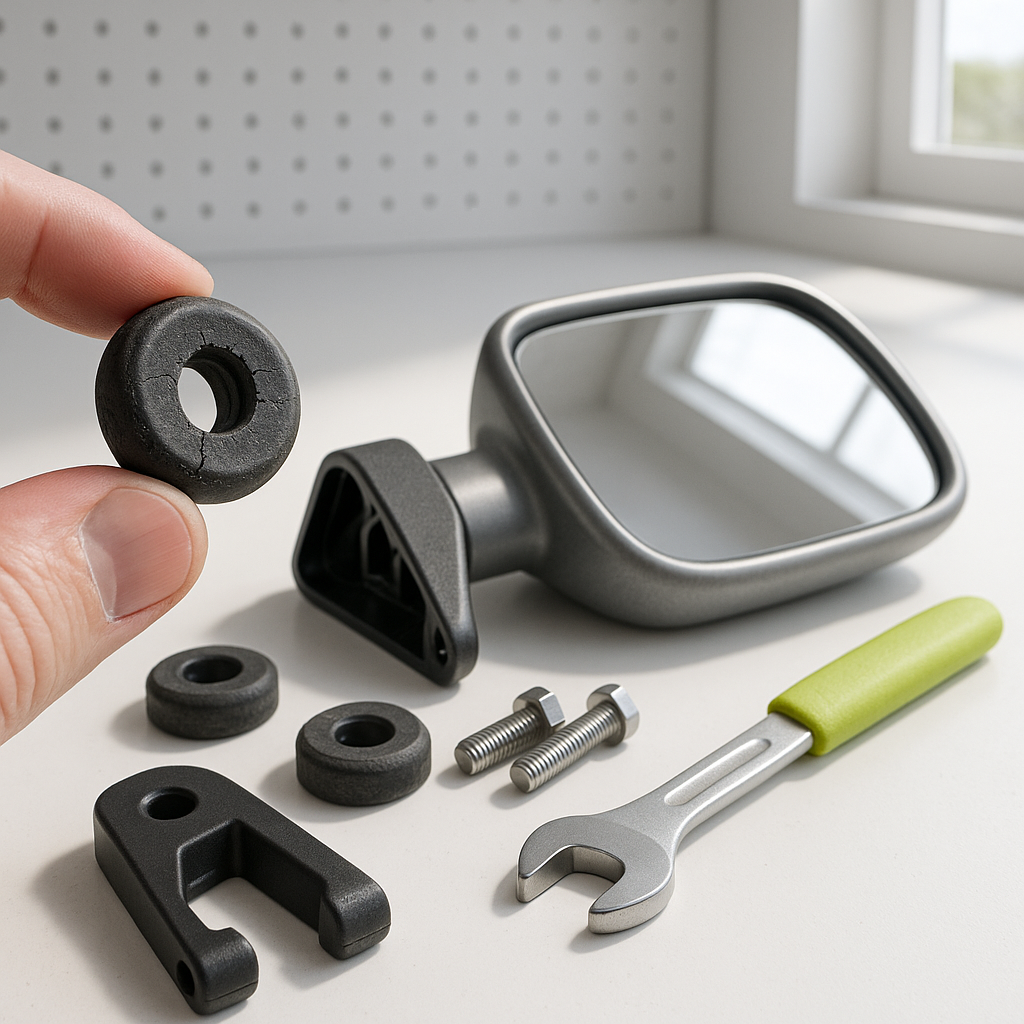
The most common source of mirror vibration isn't the mirror itself — it's the point where the mirror bracket clamps to the windshield frame, roof support, or fender. Over time, the clamping hardware loosens from normal road vibration and the constant on-and-off nature of golf cart use. Before you do anything else, grip the base of the mirror mount firmly and try to rock it. Any movement you can feel by hand will be amplified dramatically at speed. Tighten the mounting clamp or bolt and test again — this alone solves the problem the majority of the time.
Check the Mirror Arm for Play
Many golf cart mirrors use an adjustable arm or ball-and-socket joint between the mount and the mirror head. These joints are deliberately loose enough to let you reposition the mirror, which also means they're prone to developing slop over time. If the base mount is solid but the arm itself wiggles, that joint is your culprit. Some arms have a tightening nut or set screw at the pivot point — snugging that down is usually all it takes. If the adjustment mechanism is worn to the point where it won't hold tension, the joint itself may need replacing rather than just tightening.
Look at Where the Mount Is Attached
Mirror mounts that clamp to a tubular windshield frame or roll bar rely on that tube being rigid. If the tube itself has any flex or looseness where it connects to the cart body, the vibration source is actually upstream of the mirror entirely. Push and pull on the windshield frame or roof support with the cart parked. A frame that rocks even slightly will transmit vibration directly into anything mounted to it. This is especially common on older carts where frame welds or connection bolts have loosened with age. Tightening frame hardware or adding a rubber-backed bracket can significantly reduce transmitted vibration.
Consider Mirror Head Weight and Arm Length
Physics works against you with mirrors: the longer the arm and the heavier the mirror head, the more leverage there is for vibration to amplify. If you've recently upgraded to a larger mirror for better visibility — which is a legitimate safety improvement — but the existing arm wasn't designed for that weight and size, resonance at certain speeds is a predictable result. A shorter, stiffer arm or a mount closer to the mirror head's center of mass will reduce the lever effect. Some larger mirror heads also benefit from a secondary stabilizer brace running back to the roof or windshield frame.
Dampen It If You Can't Eliminate It
If everything is mechanically tight but you're still getting vibration at a specific speed range, you may be dealing with resonance — the mirror and mount are mechanically sound, but they happen to vibrate at a frequency that matches typical cart operating speeds. In these cases, adding a small amount of rubber or foam padding between the mount and the mounting surface can break the resonant frequency without requiring hardware changes. Rubber-lined clamps or even a strip of weatherstripping between a metal clamp and a metal tube is a simple and effective fix that doesn't compromise adjustability.
When the Mirror Glass Itself Is the Problem
Occasionally the vibration is coming from the mirror glass rattling within its housing rather than from the mount. This shows up as a buzzing or chattering quality to the blur rather than a smooth oscillation. Remove the mirror head if possible and check whether the glass has any play within the frame. A small strip of foam tape around the perimeter of the glass where it contacts the housing will usually eliminate this. It's the least common cause of the problem, but worth ruling out if the mount and arm are demonstrably tight.
The good news is that mirror vibration problems are almost always mechanical — they don't require special tools or deep technical knowledge to fix. Work through the mount, the arm, and the mounting surface in order before you assume the mirror itself is defective. In most cases, a few minutes with the right wrench and a firm hand test will tell you exactly where the problem is.