A golf cart mirror that technically stays mounted but still delivers a useless view is one of those problems that's easy to ignore until it isn't. If your mirror vibrates into a blur at speed, refuses to hold its angle, or gives you a reflection that's angled at the sky or the floor, you're riding without effective rearward visibility — and that matters whether you're on a crowded golf course, a neighborhood path, or a job site. Before you replace anything, it's worth working through the actual cause, because most of these problems have a specific fix rather than a general solution.
Start With the Mount: Is the Base Actually Solid?
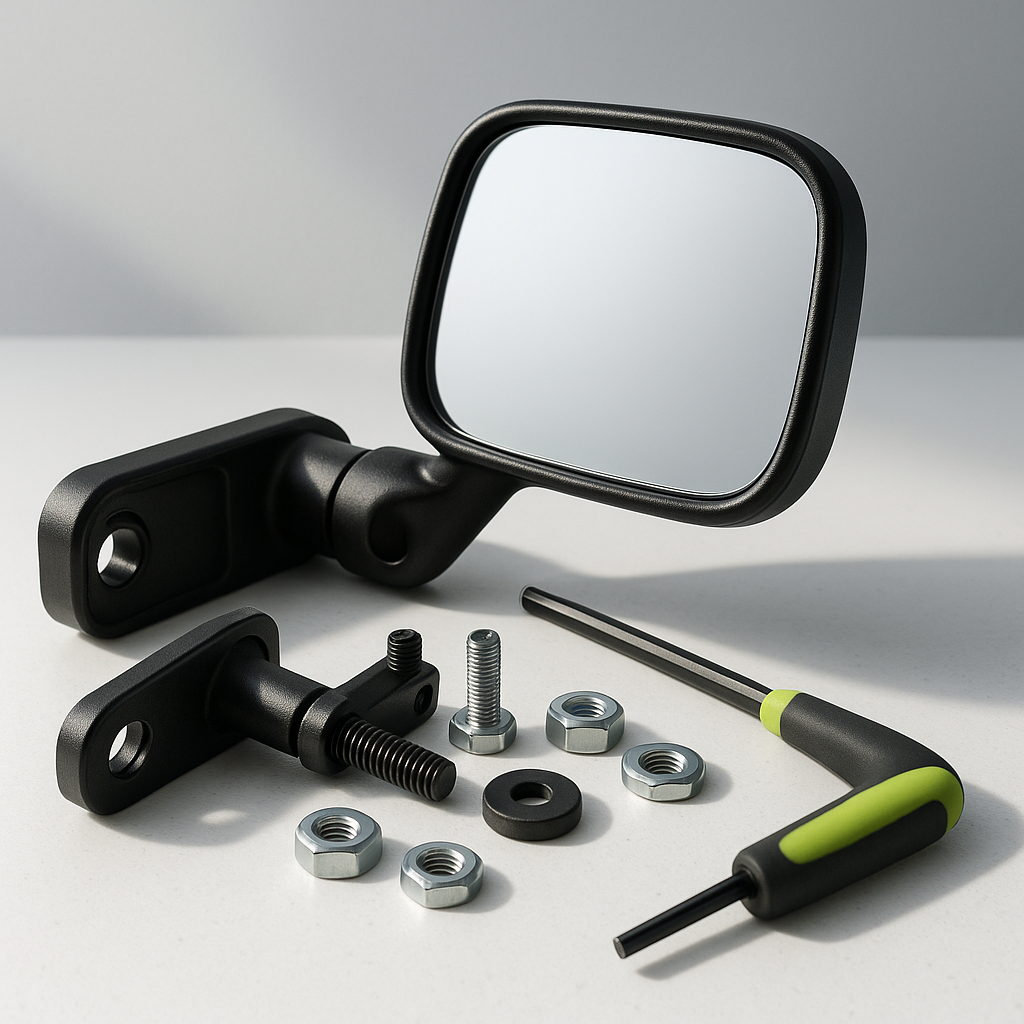
The most common reason a mirror vibrates or drifts is that the mounting point has developed play. Even a small amount of looseness at the base amplifies dramatically in the mirror glass itself, turning minor road buzz into a useless blur. Grab the mirror and try to rock it in every direction — fore-aft, side-to-side, and rotationally. Any movement that originates at the clamp or bracket rather than at the mirror arm pivot is a sign the mount has loosened. Windshield-frame mounts, strut mounts, and roof-edge clamps all rely on consistent clamping force against a surface, and that force decreases over time from vibration, temperature cycles, and just regular use. Tightening the mounting hardware is the obvious first step, but inspect the clamping surfaces too — if the bracket is biting into painted steel or thin plastic, it may need a rubber shim or a wider clamp surface to grip without slipping.
Check the Mirror Arm and Pivot Points
Many mirrors use a multi-segment arm with one or more pivot joints that allow you to adjust position. Each of those joints is a potential failure point. A pivot that was snug when new can wear loose, especially on a cart that sees rough terrain or lots of daily use. Work each joint individually — hold the arm steady on one side of the joint and try to move the other side. If you can feel or see movement that doesn't require deliberate adjustment force, that joint has worn beyond its useful friction. Some pivots can be tightened with a set screw or locking nut; others are friction-fit and simply wear out. Knowing which type you have determines whether tightening is possible or replacement is the right call.
Diagnose Why the Mirror Won't Hold Its Angle
A mirror that you adjust correctly but that slowly drifts back to a useless position is usually a friction problem. The pivot or ball joint that's supposed to hold position under driving vibration no longer has enough resistance to stay put. Sometimes this is as simple as a loose locking knob that needs to be tightened more firmly after adjustment. Other times the friction surface itself has worn smooth and no amount of tightening recovers useful hold. If the mirror has a dedicated locking mechanism — a knob, a thumb screw, or a lever clamp — make sure you're fully engaging it after every adjustment. If you're locking it firmly and it still drifts, the joint has worn and needs to be replaced. Operating the cart on rougher surfaces accelerates this failure significantly compared to smooth pavement use.
Look at the Mirror Glass Itself
Sometimes the mount and arm are fine but the image is still poor. Inspect the mirror glass for surface damage — fine scratches from cleaning with abrasive materials, crazing from UV exposure, or delamination behind the reflective coating are all common on carts that live outdoors. A degraded mirror surface produces a dim, distorted, or double-image reflection that no amount of repositioning fixes. Also check whether the glass itself is seated firmly in its housing — if it rattles or flexes in the shell, a small foam pad or rubber gasket behind it can eliminate both movement and buzzing noise without replacing the whole mirror. If the glass is cracked or the reflective coating has failed, replacement is the correct answer.
Assess Your Mounting Location
Poor visibility from a properly functioning mirror is often a placement problem rather than a hardware problem. A mirror mounted too far forward, too low, or angled in a way that's structurally fixed by its bracket may simply not cover a useful field of view for your seating position. Before concluding your mirror is defective, sit in your normal driving position and evaluate what the mirror actually shows when it's correctly adjusted. If the best achievable angle still shows mostly your own cart body or doesn't cover the area behind and to the side of you, the mounting position needs to change. Some carts have limited mounting options on the stock windshield frame, and a different bracket style — strut-mounted, roof-mounted, or side-bar-mounted — may be necessary to get the mirror into a position where it can do its job.
Factor In Your Cart's Vibration Profile
A mirror that works fine on smooth pavement but vibrates into uselessness on rough ground is telling you that the hardware is marginal for your use conditions. Carts with lift kits, larger tires, or that operate primarily on unpaved terrain generate significantly more vibration than stock carts on cart paths. In those situations, a mirror and mount that would be perfectly adequate in a lower-vibration application simply won't hold position or deliver a clear image. The fix is hardware with more robust locking mechanisms, heavier-gauge arms, and vibration-dampening features — not more adjustment. Recognizing this mismatch between your use case and your current mirror's design saves time and frustration.
When to Replace Versus When to Repair
Loose mounting hardware, worn pivot locking screws, and minor glass rattle are all repairable with the right fasteners, shims, or foam tape. But a pivot joint that has worn through its friction surface, a mirror arm that has cracked or bent, or a mirror glass with degraded coating are not worth chasing with repairs — replacement is faster, cheaper, and more reliable. The key diagnostic question is whether tightening, shimming, or adjusting returns the mirror to consistent, stable function. If you find yourself re-tightening or re-adjusting frequently, the component has worn past its service life and you're treating a symptom rather than the cause.