A mirror that's mounted but doesn't actually help you see is worse than no mirror at all — it gives you false confidence. Poor visibility in golf cart mirrors is one of those problems that's easy to ignore until you back into a post, clip a curb, or miss a cart coming up behind you. The good news is that most visibility complaints trace back to a handful of fixable causes that have nothing to do with the mirror itself being defective.
Start With the Obvious: Angle and Position
The most common reason a golf cart mirror doesn't show you what you need to see is simply that it's aimed wrong. Unlike a car mirror that you adjust from the driver's seat, most golf cart mirrors are tightened down at the mount and forgotten. Sit in your normal driving position before making any adjustments — your eye height and seat position matter. A mirror that looks correctly aimed when you're standing next to the cart will almost certainly be pointed at the wrong spot when you're seated. Adjust with your body in the actual driving position, and aim the mirror so you can see the full width of the area behind and beside the cart with minimal head movement.
Check the Mount Position on the Frame
Where the mirror is mounted on the cart dramatically affects what it can show you. A mirror clamped too far inboard on the roof frame may be blocked by the roof support itself. One mounted too low may catch the back of the seat. Roof-mounted center rearview mirrors need to be far enough forward that they aren't obstructed by the roof edge, and side mirrors need to be pushed out past the body line of the cart to give a true side-rear view. If you've never experimented with mount position — just slapped the mirror wherever the clamp fit — try moving it a few inches and see if the usable field of view improves.
Mirror Surface Problems: Scratches, Haze, and Distortion
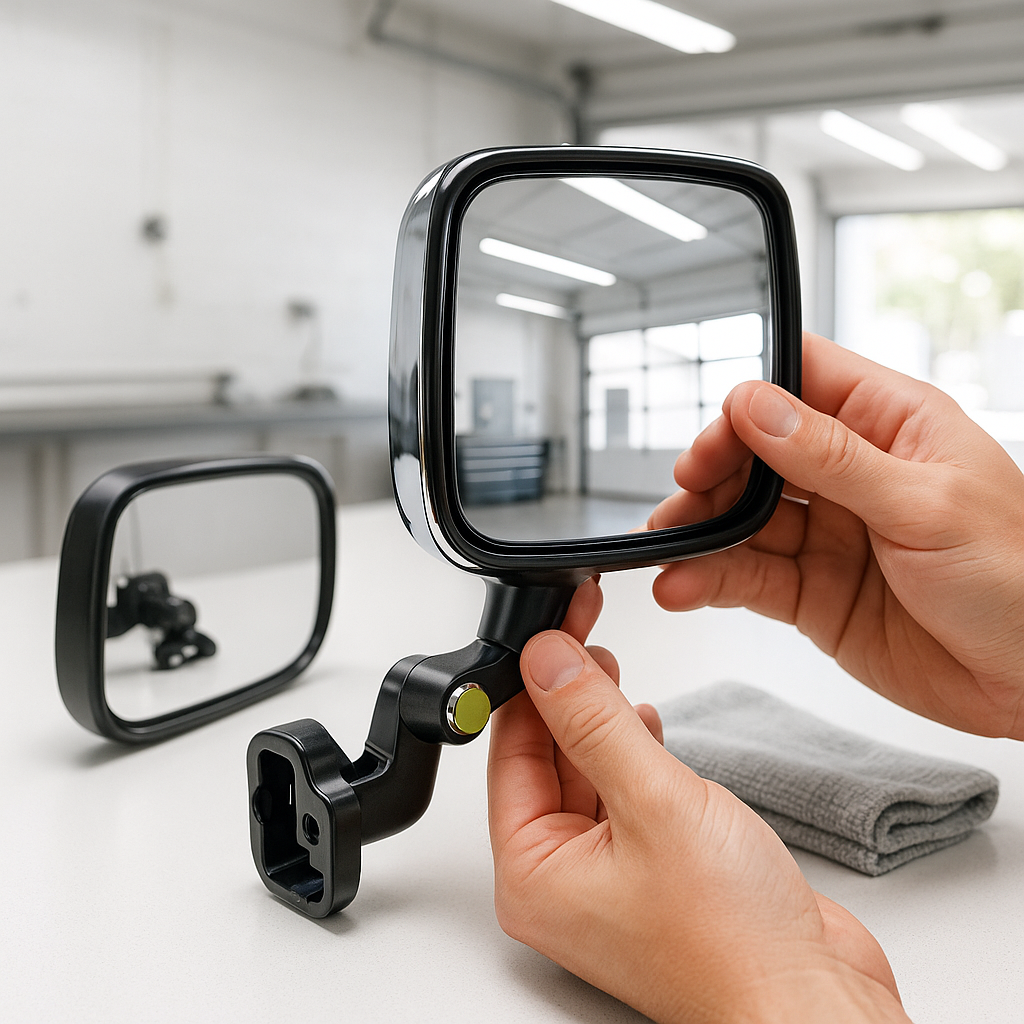
An old or low-quality mirror surface can technically be aimed correctly and still be nearly useless. Plastic mirrors scratch easily, especially if they've ever been wiped dry without rinsing. Fine scratches scatter light and create glare, making the reflected image soft and hard to read in bright conditions. Convex mirrors (which most golf cart mirrors are) can also develop surface crazing over time from UV exposure. Check the mirror surface in direct sunlight — if the reflection looks foggy, speckled, or distorted at the edges, the mirror glass or plastic itself is the problem. A mirror in this condition can't be fixed with adjustment; the reflective surface needs to be replaced.
Vibration Blur vs. True Optical Problems
Sometimes what looks like a visibility problem is actually a vibration problem in disguise. If your view is clear when the cart is stationary but blurry or doubled while moving, the mirror is vibrating enough to make the image unreadable. This is different from a scratched or fogged mirror surface. Check that the mount clamp is tightened fully, that the mirror stem isn't bent or cracked at the joint, and that the ball-and-socket or pivot point isn't worn loose. A small amount of mirror movement at the head amplifies into a lot of image movement at highway cart speeds — even a slightly loose clamp can cause enough oscillation to make the view useless while driving.
Field of View: Single Mirror vs. Dual Setup
One overlooked reason golf cart mirrors seem to show very little is that a single center-mounted rearview mirror simply can't cover the blind spots on either side of the cart, especially on wider lifted carts or carts with rear seat attachments. If you've maxed out your adjustment and still have large dead zones, the honest fix is adding a second mirror — either a second side mirror on the opposite side, or switching from a single center mirror to a dual side-mirror setup. Convex mirrors with a wider angle of curvature also show more of the area behind you at the cost of some size accuracy, which is a worthwhile tradeoff for low-speed utility use where you mainly need to know something is there.
When to Replace vs. Readjust
Run through this checklist before assuming you need a new mirror: Is the mirror aimed from your actual seated driving position? Is the mount located where it has a clear line of sight? Is the mirror stem and clamp tight with no play? Is the reflective surface free of deep scratches, crazing, or haze? If the answer to all of those is yes and you still can't get a usable view, the issue is likely the mirror's design — either the size is too small, the curvature isn't right for your cart's geometry, or the mounting style doesn't put the mirror where you actually need it. At that point, replacement with a mirror that fits your specific cart style and use case will solve what adjustment alone can't.