A golf cart mirror that gives you a blurry, distorted, or severely limited view isn't just annoying — it's a genuine safety issue, especially when you're sharing paths with pedestrians, other carts, or vehicle traffic. The good news is that most visibility problems with golf cart mirrors fall into a handful of categories, and working through them systematically will almost always identify the culprit. This guide covers the real reasons your mirrors might be failing you, and what you can actually do about each one.
Start With the Mirror Glass Itself
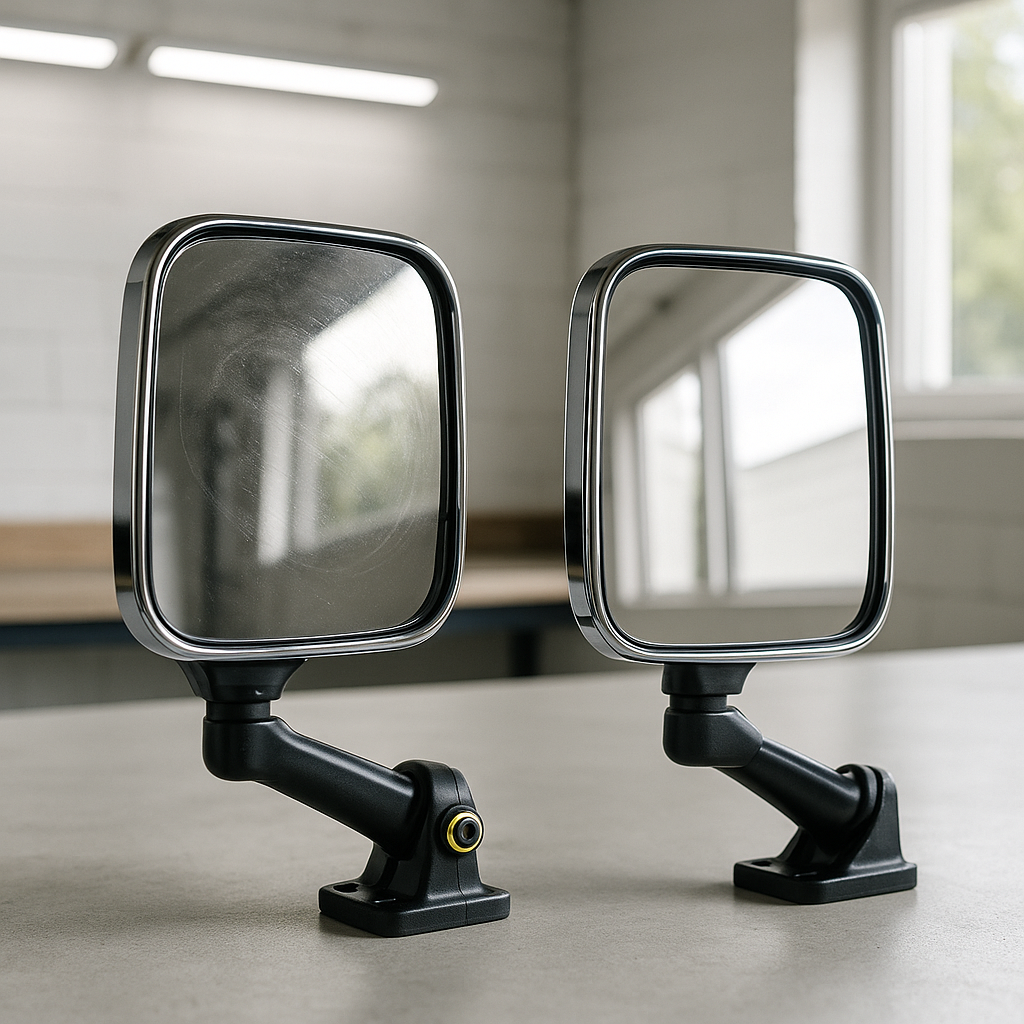
The most obvious place to start is the mirror surface. Scratched, hazy, or yellowed mirror glass dramatically reduces the quality of what you see behind you — sometimes so gradually you don't notice how bad it's gotten. Hold the mirror at an angle in good light and look at the surface directly. Fine scratches scatter light and create a washed-out reflection; deep scratches create distracting blind streaks. Surface haze or yellowing on older mirrors often comes from UV exposure degrading a coating or the backing material. If the glass itself is compromised, no amount of adjusting or cleaning will fix it — replacement is the only real solution. Check whether your current mirrors use replaceable glass inserts or require full mirror replacement.
Check Your Viewing Angle and Coverage
A mirror that's physically fine but mounted in the wrong position — or simply too small for your needs — will still give you terrible visibility. Sit in your normal driving position and assess honestly: can you see the full lane or path width behind you without craning your neck? Side mirrors should ideally let you see the rear quarter of the cart body and beyond in one glance. If you have a single rearview mirror and find yourself with large blind zones to either side, the issue isn't a defect — it's that a single small mirror genuinely can't cover everything. This is a common situation on wider lifted carts or carts with rear-facing seats or cargo beds, where additional side mirrors may be necessary for adequate coverage. Flat mirrors also provide a true-size but narrower field of view compared to convex mirrors, which give a wider panoramic view at the cost of distance accuracy — both are valid tradeoffs worth understanding.
Diagnose Vibration-Caused Blur
If your mirror looks fine when the cart is parked but becomes a useless vibrating blur while driving, the problem is mechanical. Check the mounting hardware first — bolts or clamps that have loosened over time are the single most common cause. Hand-tighten everything and test. If the hardware is snug but vibration persists, look at where the mirror mounts to the cart. A mirror mounted on thin sheet metal or a plastic body panel will transfer far more vibration than one bolted to a roll bar or solid tubular frame. The length of the mirror arm matters too: longer arms amplify vibration at the mirror head. If your current mount location is inherently vibration-prone, consider whether a different mounting point would be more stable, or whether a mirror with a shorter, stiffer arm would reduce the problem.
Look at Lighting and Glare Conditions
Sometimes the mirror isn't the problem at all — lighting conditions are. Low sun angles, driving into the shade after being in bright sunlight, or oncoming headlights at dusk can all make even a perfect mirror nearly useless momentarily. This is especially noticeable with highly polished chrome mirror housings that can cause secondary glare. If you notice visibility is consistently poor at certain times of day or in certain lighting, a mirror with a matte or flat-black housing will reduce this significantly. For carts used regularly in the evening, make sure any lights on the cart aren't angled in a way that reflects back into your mirrors.
Consider Mirror Size and Type for Your Setup
If you've worked through the checks above and your mirrors are simply inadequate for how you use your cart, that's a legitimate diagnosis in itself. A small flat mirror designed for a basic two-seat cart is not going to give acceptable visibility on a stretched six-passenger cart, a cart with a rear cargo box, or a lifted cart where the roofline and body proportions have changed. Convex mirrors cover more area but can make objects appear farther away than they are — useful for wide-angle coverage, but not ideal as your only mirror if you need accurate distance judgment. Flat mirrors give truer perspective but require better positioning to cover the same field of view. Most drivers benefit from a combination: a wider convex mirror for general rear coverage and a flatter side mirror for the lane directly behind. Matching the mirror type and size to your actual cart configuration is often the missing piece when nothing else seems to solve the problem.
Universal vs. Model-Specific Fit
One underappreciated source of visibility problems is a mirror that was never quite right for the cart to begin with. Universal mirrors are designed to fit a broad range of carts, but the mounting hardware, arm length, and adjustment range may not position the mirror optimally for your specific cart's seat height, roof height, or body width. If a mirror consistently won't hold the angle you need — or requires an awkward adjustment that puts the housing out of range — it may be that the mount geometry just doesn't suit your cart well. In these cases, a model-specific mirror designed for your cart brand (Club Car, EZGO, Yamaha, etc.) will typically offer better-optimized positioning and a more secure fit on the existing mounting points.