A mirror that won't hold its position is more than annoying — it's a real safety problem. If you glance over and find it pointing at the roof or the ground, you've lost the visibility it was supposed to provide. The good news is that mirrors losing their adjustment is almost always a mechanical issue with the mounting hardware, not a defect in the mirror itself, and it's almost always fixable without replacing the whole unit.
Why Mirrors Lose Adjustment Over Time
Golf carts vibrate more than most people expect. Even at low speeds, the motor, road surface, and general chassis flex create constant low-level vibration that works fasteners loose over time. Most golf cart mirrors use either a ball-and-socket swivel joint or a pivot bracket to allow angle adjustment. Both systems rely on friction or a locking fastener to hold position — and both can lose their grip gradually. Heat and UV exposure also affect the plastic and rubber components in many mirror joints, making them stiffer initially but then brittle and loose as they age.
Check the Pivot or Swivel Joint First
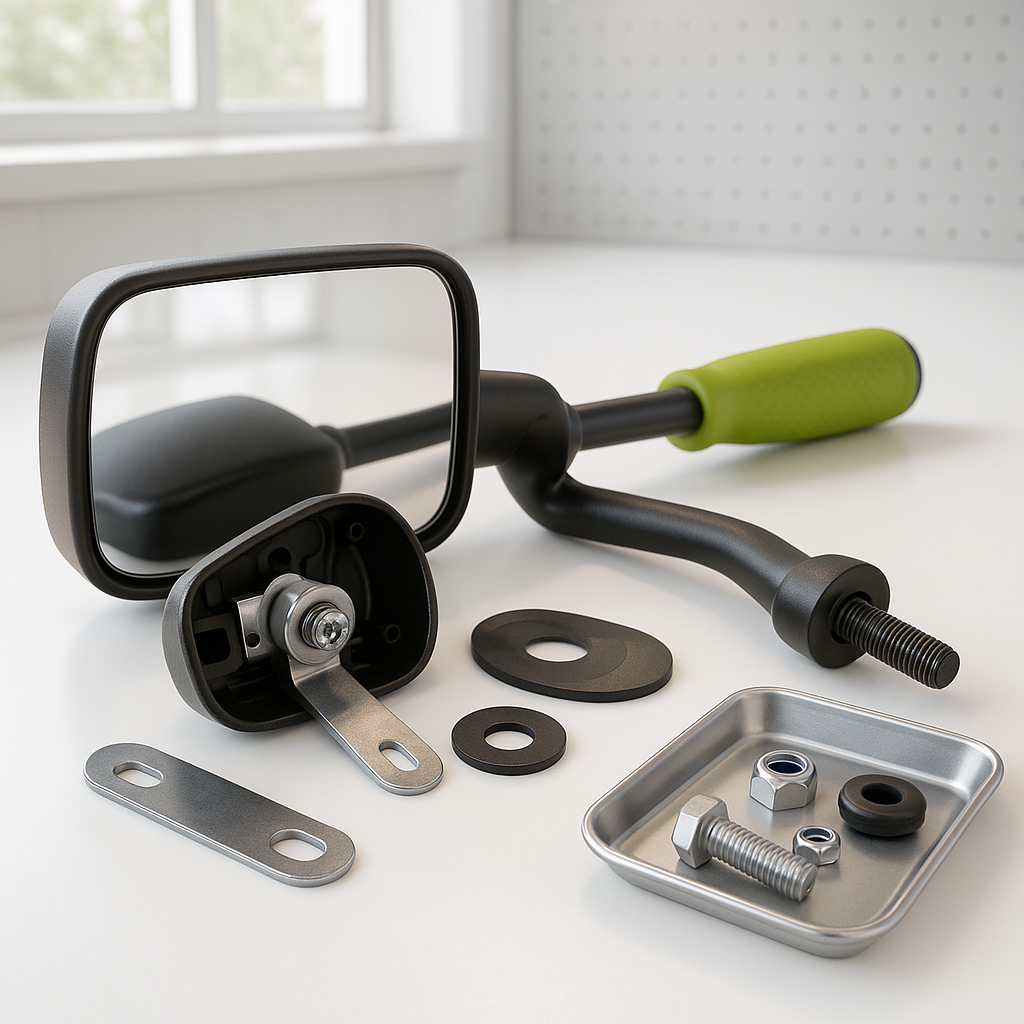
Start by moving the mirror head through its full range of motion by hand. If it swings freely with almost no resistance, the joint is the problem. On bracket-style mirrors, there's usually a bolt or screw at the pivot point that can be tightened — often hidden under a cap or cover. On ball-and-socket designs, the socket itself may have worn out and no longer grips the ball tightly enough to hold position against vibration. Try tightening any visible fasteners at the joint first. If the joint is plastic and visibly cracked or deformed, no amount of tightening will fix it reliably — replacement is the honest call.
Check Where the Mirror Arm Mounts to the Cart
The adjustment problem sometimes isn't in the mirror head at all — it's at the base where the arm connects to the windshield frame, roof support, or dash. If that connection is loose, the entire mirror assembly rotates or droops as a unit. Grab the mirror arm close to the mount point and try to wiggle it. Any movement there means the clamp or mounting bracket isn't holding. Tighten the mounting hardware at the base before worrying about the mirror head. For clamp-on mounts that grip a round tube, make sure the clamp is sized correctly for that tube — an oversized clamp will never hold reliably no matter how tight you run it.
Threadlocker Can Make a Real Difference
On mirrors where tightening the fastener solves the problem temporarily but it keeps coming loose again, vibration is working the fastener back out. A small amount of medium-strength threadlocker (the type that's still removable with hand tools if needed) applied to pivot bolts or mount screws will prevent them from backing out without making future adjustment impossible. Don't use permanent-strength threadlocker on any joint you'd ever want to readjust — medium-strength is the right call for most mirror hardware.
When the Mirror Head Itself Is the Problem
Some mirror heads — particularly older or lower-quality ones — have a swivel mechanism that simply wears out and can't be tightened further. If you've addressed the mount and pivot fasteners and the mirror still droops, check whether the head can be replaced separately from the arm. On many universal-style mirrors, the head, arm, and mount are separate components, and swapping just the head is straightforward and inexpensive. If the whole assembly is molded as one piece, full replacement is the path forward.
Check the Mirror Glass or Housing for Stress Cracks
While you're diagnosing the adjustment issue, take a close look at the mirror housing and any visible mounting tabs on the mirror head. Plastic housings can develop hairline cracks at stress points — especially around pivot holes — that make it impossible to apply enough clamping force to hold adjustment. Flex the housing gently by hand and look for any cracking or white stress marks around fastener holes. A cracked housing won't hold a fastener reliably and is worth replacing rather than fighting.
After Fixing It, Verify Your Sightlines Before You Drive
Once you've tightened or replaced whatever was loose, sit in the driver's seat in your normal driving position and deliberately set the mirror angle the way you actually want it. Then take the cart over a rough patch of ground — a curb cut, gravel, or even a bumpy section of path — and come back to check whether the mirror held. If it stayed put through that test, you've solved the problem. If it moved even slightly, there's still a loose joint somewhere in the system that needs more attention before the mirror will be reliable.