If your golf cart pulls sharply to one side when you hit the brakes, or feels like something is dragging even when you're not braking at all, don't ignore it. These symptoms point to an imbalance in your braking system — one side is doing more work than the other, or one side is partially engaged all the time. Both situations put extra wear on components and, more importantly, make the cart harder to control. The good news is that the causes are usually mechanical and visible once you know where to look.
Start With the Easy Check: Is It Always There, or Only Under Braking?
The first thing to figure out is when the pulling or dragging actually happens. If the cart pulls only when you apply the brakes, the problem is almost certainly uneven braking force — one wheel is grabbing harder than the other. If you feel drag or resistance all the time, even at low speed with no pedal input, then a brake component on one side is likely seized or stuck in a partially applied position. These two scenarios have different root causes, so identifying which one you're dealing with narrows your diagnosis considerably before you touch anything.
Check Brake Cable Adjustment and Condition
On most golf carts, the rear brakes are mechanically actuated by cables. If one cable is stretched, frayed, kinked, or adjusted more tightly than the other, that wheel's brake will engage sooner or with more force — causing a pull. Inspect both cables along their full length. Look for fraying near the ends where they attach to the brake actuating arm, kinks where they pass through guides or brackets, and corrosion at the cable housing. Also check that the cable is seated properly in its adjuster and hasn't slipped. A cable that has lost tension on one side means that side's brake is applying less force, so the other side dominates — which also causes a pull. Cables that are frozen or sticky inside the housing can cause a brake to stay partially applied, which creates the constant drag scenario.
Inspect the Brake Drums and Shoes for Uneven Wear
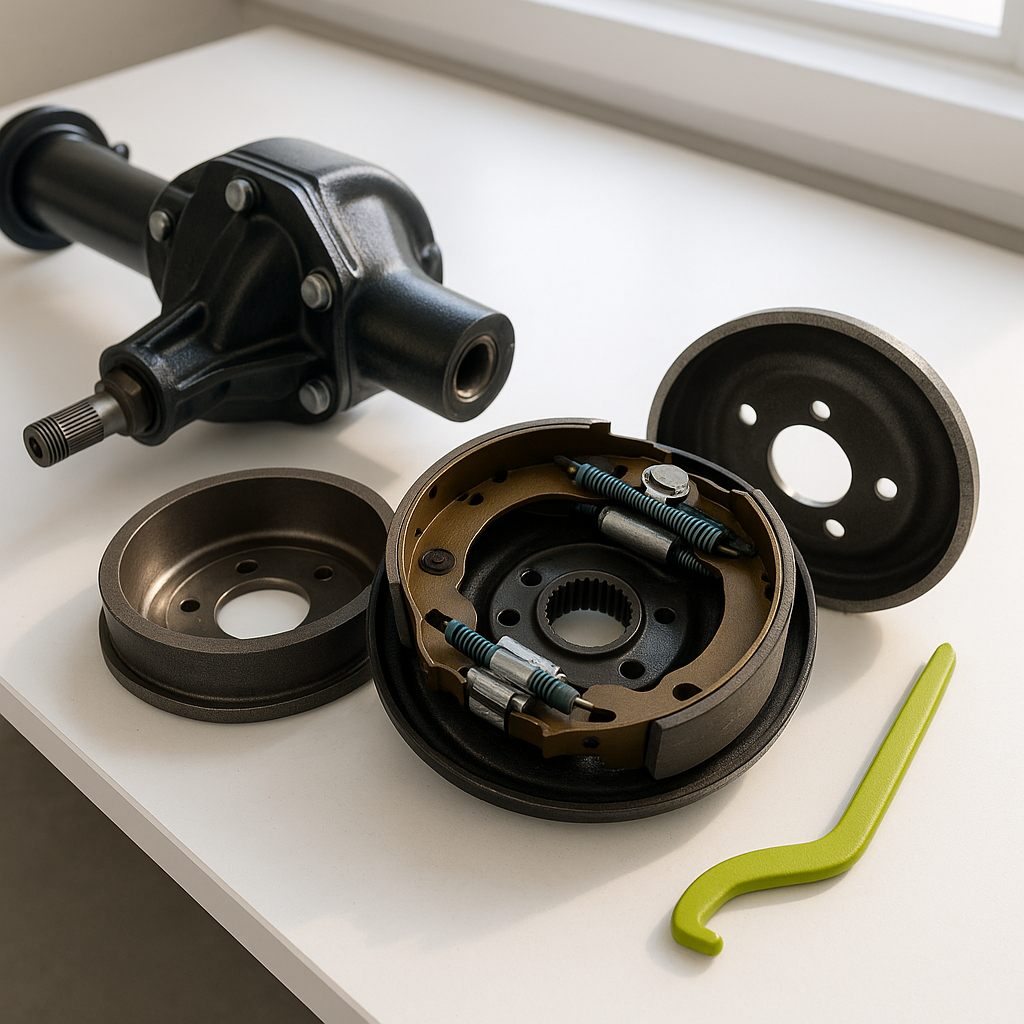
If the cables check out, pull the rear wheels and inspect the brake drums. Look for scoring, heat discoloration, or a glazed surface — any of these reduce the friction surface and change how that brake grabs. Then inspect the brake shoes themselves. If the lining on one side is significantly thinner than the other, or if one side shows signs of contamination (oil, grease, or brake dust buildup), that shoe won't generate consistent friction. Contaminated brake linings, often from a leaking axle seal, almost always cause an uneven pull because grease dramatically reduces braking effectiveness on that side. Replace contaminated shoes — cleaning them rarely restores consistent performance.
Check for Seized Wheel Cylinders or Stuck Hardware
On carts with drum brakes, the wheel cylinder is the hydraulic component that pushes the shoes outward against the drum. If a wheel cylinder is seized in the applied position, that brake will drag constantly and the wheel will feel stiff to spin by hand. If it's seized in the retracted position, that side won't brake effectively and the other side will cause a pull. Spin each rear wheel by hand with the brake released — it should turn smoothly with only light resistance. If one wheel is noticeably harder to turn, that's your dragging side. Also check the return springs on the brake shoes. Weak or broken springs won't pull the shoes back fully after braking, which causes drag and accelerated wear on that drum.
Don't Forget Brake Pad and Rotor Condition on Disc Brake Carts
Some newer or higher-end carts use disc brakes, typically on the front. On these systems, a pulling sensation under braking usually points to a stuck caliper piston on one side, a seized caliper slide pin, or significantly different pad thickness between sides. A stuck caliper piston causes constant drag and heat buildup — the rotor on that side will be noticeably hotter than the other after a short drive. Slide pins that aren't lubricated properly can cause the caliper to apply unevenly across the pad surface, wearing the inner pad much faster than the outer. If you have disc brakes and the cart pulls under braking, visually compare pad thickness on both sides and check whether the caliper moves freely on its mounting hardware.
When to Adjust vs. When to Replace
Cable adjustment is often the first fix to try if you're dealing with a pull and the components themselves look good. Most brake systems have an adjuster at the cable end or at the brake backing plate that lets you equalize tension between sides. Make small adjustments, test, and repeat — don't over-tighten one side trying to compensate. If the pull is caused by worn shoes, a scored drum, a leaking axle seal, or seized hardware, adjustment alone won't solve it. Those components need to be replaced. Running on mismatched or compromised brake components is a safety risk — the pull you feel at low speed on a flat surface becomes a much bigger problem on a hill or in an emergency stop situation.