Installing a lift kit is one of the most satisfying upgrades you can make to a golf cart — more ground clearance, bigger tires, a more aggressive stance. But a rough, bouncy, or jarring ride after a lift install is a genuinely common complaint, and it's almost never just "that's how lifted carts feel." There's usually a fixable mechanical reason behind it, and most of them are diagnosable without special equipment. Here's how to work through it systematically.
Start With the Obvious: Tire Pressure
Before you dig into any mechanical diagnosis, check your tire pressure across all four tires. Larger tires — the kind typically run with a lift — are more sensitive to pressure variation than stock golf cart tires. An overinflated tire on a lifted cart with stiffer geometry will transmit every bump straight through the frame. Under-inflation creates its own wallowing instability. Set all four tires to the manufacturer's recommended pressure for the specific tire size you're running, and recheck after the tires have warmed up slightly. It's a five-minute step that rules out the most common cause of post-lift harshness.
Inspect the Lift Blocks and Spacers
Many lift kits — particularly block-style lifts — work by adding a spacer between the axle or suspension component and the frame. If any of those blocks or spacers are loose, cracked, or improperly seated, you'll feel it as a clunk or sharp jolt over bumps rather than a smooth (if firmer) ride. With the cart parked on a flat surface, visually inspect each lift block. Look for gaps, movement, or cracking in the block material. Then try to rock each wheel by hand — grab it at the 9 o'clock and 3 o'clock positions and push-pull. Any looseness in the lift hardware will show up here. Torque all mounting hardware to the values specified in your lift kit's documentation.
Check the Shocks or Leaf Springs
If your cart had shocks before the lift, the lift kit may have either reused them in a new position or included replacement units. Shocks that are now operating at an angle they weren't designed for — or that are simply worn out and were masked by stock geometry — will feel harsh or bouncy under a lifted setup. Grab each shock and compress it by hand if accessible, or look for visible oil leakage around the shaft, which is a clear sign of a blown shock. For leaf spring setups, look for broken or separated leaves and check that all U-bolt hardware is snug. A sagging or cracked leaf spring will feel harsh and uneven, and it's more common on older carts after a lift changes the load distribution.
Look for Binding in the Spindles or A-Arms
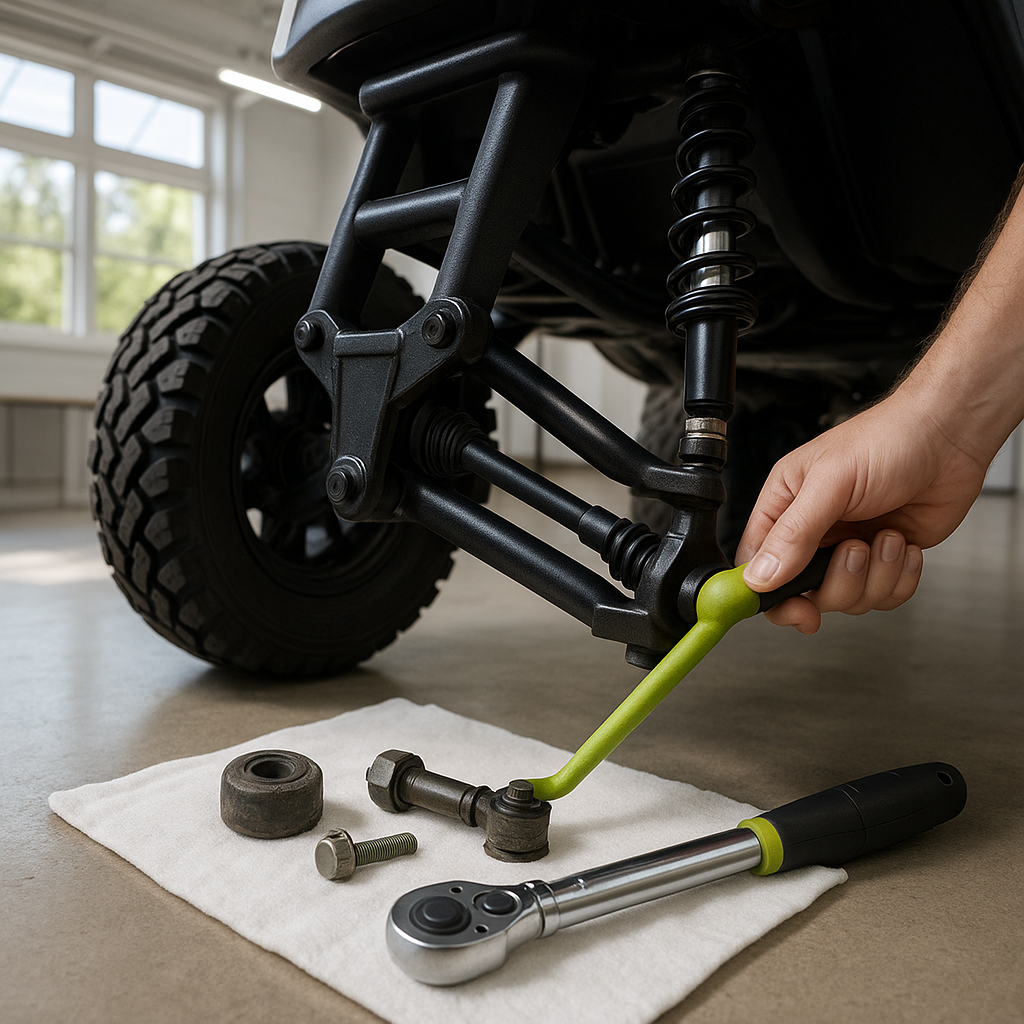
Spindle-style lift kits that add drop spindles or extended A-arms can introduce binding in the suspension travel if components aren't properly aligned during installation. A binding suspension doesn't compress smoothly — it holds firm until a bump overcomes the friction, then releases abruptly, which feels exactly like a harsh, choppy ride. Have someone push down on each corner of the cart while you watch the suspension move. It should travel smoothly and return without sticking or snapping. Any hesitation or abrupt movement points to a binding joint, misaligned component, or a fastener that's been over-tightened and is restricting movement. Pivot bolts through bushings should be snug but not so tight they prevent articulation.
Check Alignment and Camber
A lift — especially a spindle or A-arm lift — changes suspension geometry, and if the cart wasn't re-aligned after installation, the tires may be running with improper camber or toe. This won't always feel like roughness in the traditional sense, but it creates uneven tire wear, a tendency to wander, and a vague instability that owners often describe as "rough" or "unsettled." Stand back and look at your front tires straight-on — they should be close to vertical, not visibly angled in or out at the top. If you see obvious camber issues or if the cart pulls consistently to one side, alignment is likely the culprit and deserves a proper check with alignment tools or a professional set-up.
Rule Out Wheel and Hub Hardware
Larger wheels run with lift kits add rotational mass, and any imbalance in that mass gets amplified at speed. If the roughness you're feeling is more of a vibration that worsens as you go faster rather than a jolt over specific bumps, wheel balance is worth investigating. Also check that all lug nuts are properly torqued — they can loosen after the first several miles on a fresh install — and inspect hub adapters if your wheels required them. A loose or improperly seated hub adapter creates a vibration that's easy to confuse with a suspension problem.
When to Revisit the Installation Itself
If you've worked through all of the above and the ride is still unacceptably rough, the most honest answer is often that something in the installation needs to be redone. Lift kit instructions vary in quality, and it's not uncommon for a component to be installed in the wrong orientation, for a spacer to be placed on the wrong side of a bracket, or for hardware to have been skipped entirely. Pull out the installation documentation and compare it step by step against what's actually on the cart. If the kit came with specific torque specs, use a torque wrench and verify them. A systematic re-inspection of the installation is almost always more productive than guessing at add-on fixes.