A golf cart seat that moves when it shouldn't is one of those problems that starts as a mild annoyance and quietly becomes a hazard. If the seat rocks side to side, slides forward under braking, or feels like it might detach entirely, you need to track down the cause before it gets worse. The good news is that most seat stability problems come down to a handful of well-known failure points, and nearly all of them are fixable without specialized tools.
Start With the Mounting Hardware
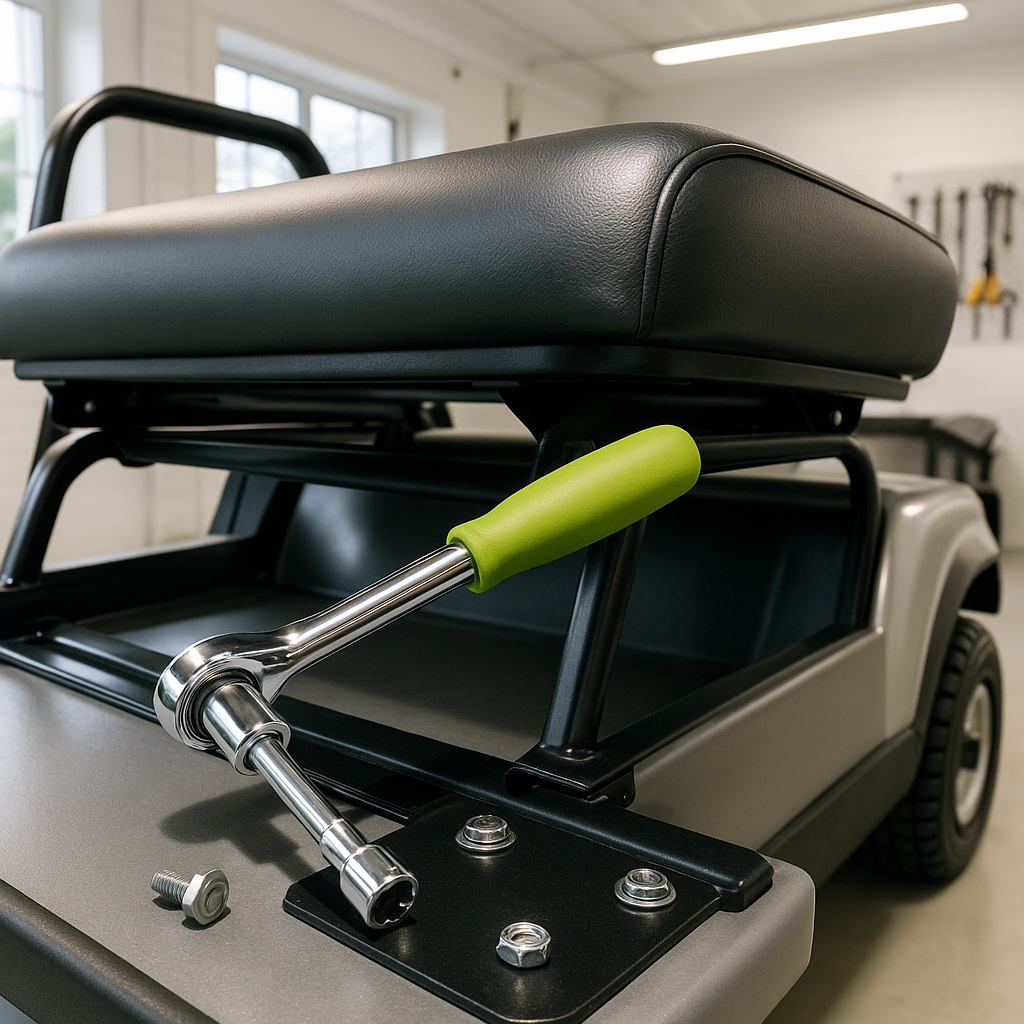
The most common cause of a loose seat is straightforward: fasteners that have backed out over time. Golf carts vibrate constantly on uneven terrain, and that vibration works bolts and nuts loose gradually — often so slowly you don't notice until the seat is visibly rocking. Pull back the seat base or flip up the cushion to expose the mounting points and check every bolt by hand. If anything turns more than a fraction, that's your first culprit. Tighten everything down and check whether a thread-locking compound is appropriate for those fasteners — on frequently-vibrated connections it often is. While you're in there, inspect the mounting holes in the seat frame itself. Worn or elongated holes mean the fastener has been moving for a while, and tightening alone won't fully solve it.
Check the Seat Frame for Damage or Cracks
On older carts, the seat frame — whether steel or aluminum — can develop cracks or bends at stress points, usually near the corners or around mounting hole locations. A cracked frame will flex even when the fasteners are tight, giving you that unsettling wobble that no amount of bolt-tightening will cure. Run your hand along the underside of the frame and inspect visually in good light. Hairline cracks can be easy to miss; look for paint bubbling, rust streaks, or deformation as secondary clues. A bent or cracked frame usually needs to be replaced rather than repaired — welding around seat mounting points is possible but should only be done by someone who can verify the structural result.
Inspect the Seat Mounting Brackets and Subframe
Between the seat frame and the cart's body there are typically one or more mounting brackets or a subframe. These can loosen from the cart body independently of the seat-to-bracket connection, so you can have two separate loose joints stacked on top of each other. Check both interfaces. Also look at the condition of any rubber grommets or spacers in the mounting stack — these are often used to dampen vibration, but when they deteriorate they compress unevenly and introduce play. Deteriorated grommets look flattened, cracked, or misshapen, and replacing them is inexpensive.
Sliding Seats: Check the Seat Track Mechanism
If your cart has an adjustable seat that slides forward and backward, a seat that moves under braking or acceleration is almost always a locking mechanism failure. The track latch — usually a spring-loaded lever or pin — either isn't engaging fully or has worn to the point where it can't hold the seat under load. Try re-engaging the lock and giving the seat a firm push-pull test before sitting down. If it moves, the latch mechanism itself needs attention. On many designs the latch spring can be replaced individually; on heavily worn tracks, replacing the full track assembly is the cleaner fix. Also check that the track rails themselves aren't bent — a bent rail prevents the latch from seating correctly even if the latch mechanism is intact.
Don't Overlook the Cart's Floor or Body Mount Points
Sometimes the problem isn't the seat hardware at all — it's what the seat is bolted to. Golf cart floors, particularly fiberglass or plastic composite bodies, can crack around high-stress areas like seat mount locations. If the floor flexes visibly when you press down on the seat, the mount point itself has failed. A floor mat or interior liner can hide this kind of damage for a long time, so lift any floor covering and inspect the actual surface around each bolt hole. Cracks in fiberglass can be repaired, but the repair needs to fully restore structural rigidity at that location — surface patching isn't sufficient if the area is still flexing under load.
After Repairs, Do a Proper Load Test
Once you've addressed whatever you found, don't just sit down and assume it's fixed. Apply real weight — sit in the seat and deliberately shift your weight forward, backward, and side to side. Do the same with a passenger if the seat is a two-person bench. Then take a slow test drive over uneven ground and pay attention to any new sounds or movement. A repair that holds on flat pavement can still fail under dynamic load. If anything still moves, go back and re-examine the full mounting stack rather than just retightening the last fastener you touched — multiple failure points at once are common on older carts that haven't had regular maintenance.