A little slop in a golf cart steering wheel is easy to ignore, especially at low speeds on flat ground. But if you're turning the wheel several inches before the front tires actually respond, that's not normal wear — it's a problem that compounds quickly. Loose steering makes the cart unpredictable on hills, around pedestrians, and on uneven terrain. The good news is that most causes are mechanical and visible once you know where to look.
Start With a Simple Wiggle Test
Before crawling under anything, park the cart on level ground and turn the wheel off. Grip the steering wheel at the 3 and 9 o'clock positions and try to move it side to side — not in a turning motion, but laterally. Then push and pull it toward and away from you. Any movement other than normal rotation points to a worn steering column or loose column mounting hardware. Next, have a helper hold the wheel steady while you watch the front wheels from outside the cart. If the wheels barely move when the wheel is turned back and forth a few inches, you have play in the steering linkage itself, not just at the column.
Check the Steering Column and Coupler
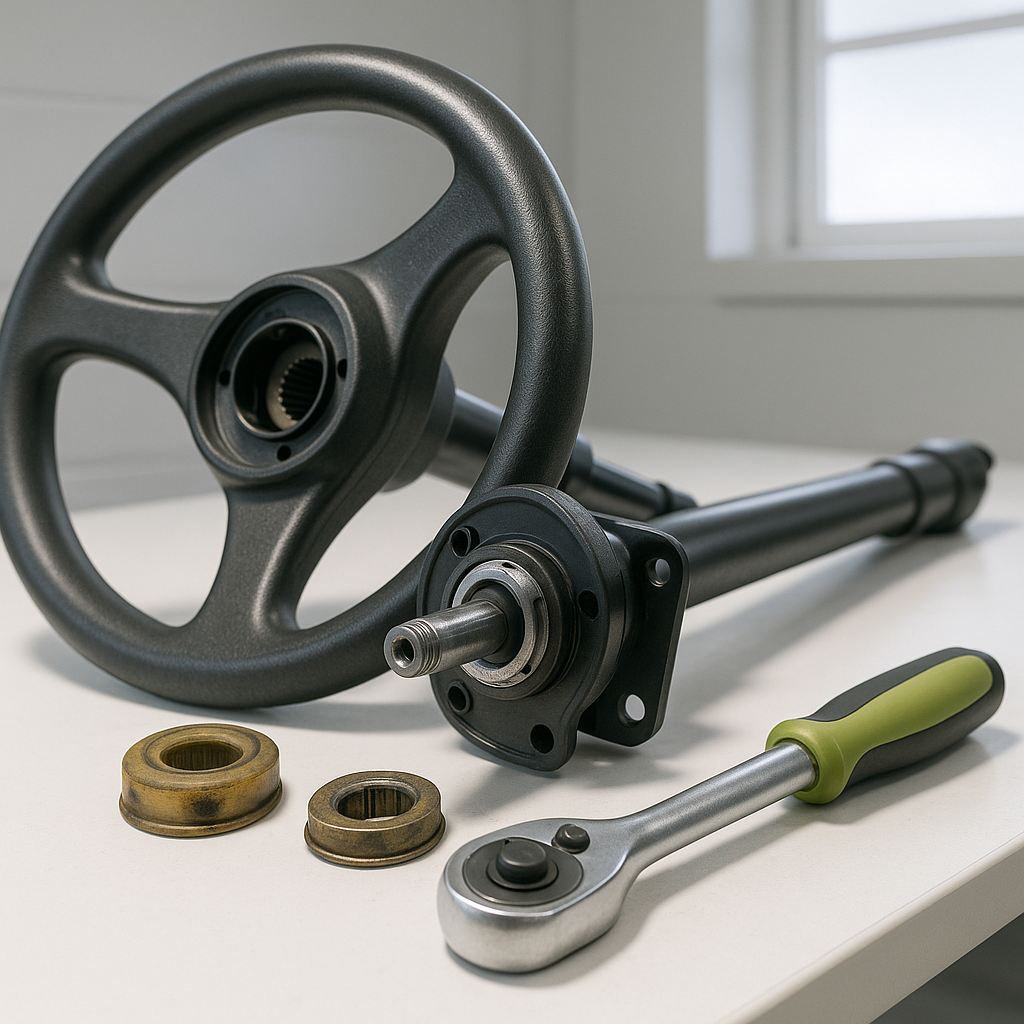
The steering column connects the wheel to the steering box or rack through a coupler or u-joint. These couplers are a very common source of slop on older carts, especially those that have seen a lot of hours or moisture. Locate the coupler — it's typically under the dash or just above the front crossmember — and inspect it for cracking, twisting, or visible looseness where it connects on either end. On many carts, this coupler is a rubber or splined piece that degrades over time. If it spins freely or rocks when you twist it by hand, it needs replacement. Also check that the column mounting brackets are tight and not cracked at the dash frame.
Inspect the Tie Rods and Tie Rod Ends
Tie rod ends are ball-and-socket joints that connect the steering rack or drag link to the front wheel spindles. They wear out, and when they do, they introduce slop that feels exactly like steering wheel play. To check them, lift the front of the cart safely on jack stands, grab each front tire at the 9 and 3 o'clock positions, and try to wiggle it. Any clunking or visible movement at the tie rod end joint means it's worn. Also check the tie rod tubes themselves — they shouldn't be bent, and the adjustment sleeves should be clamped down firmly. Loose clamps can let the tie rod length shift, which throws off alignment and adds apparent play.
Look at the Steering Box or Rack
Golf carts use either a steering box (more common on older and heavier-duty designs) or a rack-and-pinion setup. Both can develop internal wear that creates dead zones in the center of steering travel — that classic feeling where you turn the wheel an inch or two and nothing happens. On a steering box, there is sometimes an adjustment screw that controls preload on the sector gear. This can be carefully adjusted to reduce play, but overtightening it causes stiff steering and premature wear, so proceed carefully or have a shop do it. Rack-and-pinion units generally can't be adjusted — if the rack itself is worn, replacement is the fix.
Don't Overlook the Wheel Itself
It sounds obvious, but the steering wheel hub nut works loose more often than people expect, especially on carts that see rough ground or have had the wheel removed and reinstalled at some point. Find the center cap, pull it off, and check whether the nut holding the wheel to the column shaft is tight. On most carts this requires a socket and a firm hand — the nut should be snug with no wobble when you try to rock the wheel on its shaft. A loose hub nut gives the wheel a small amount of rotational slop that feels like linkage play and is one of the easiest fixes on the list.
Kingpin and Spindle Wear
On carts with kingpin-style front axles (common on many older designs), the kingpins themselves wear over time. To check, support the front of the cart securely, grab the tire at the top and bottom, and try to rock it in and out. Movement here — especially with a clunking sound — suggests worn kingpin bushings. This is a more involved repair than tie rod ends but is still a DIY job for someone comfortable with front-end work. Neglecting kingpin wear doesn't just cause play; it eventually affects camber and causes uneven tire wear.
When to Stop Diagnosing and Just Fix It
If you've worked through these checks and identified the worn component, great — prioritize the repair before driving the cart further, especially if children or passengers are involved. If you find multiple issues — say, worn tie rod ends and a sloppy coupler — address them together rather than one at a time, because combining worn components makes it hard to know if a single repair actually solved the problem. And if you can't identify the source of the play, a front-end inspection at a small engine or golf cart shop is money well spent. Steering is not the place to tolerate uncertainty.