Golf cart tire problems rarely announce themselves clearly. You might notice the cart pulling to one side, feeling sluggish on a full charge, or you keep finding one tire soft every few days. Before you assume you need new tires — or worse, ignore it entirely — it's worth working through a proper diagnostic. Most tire issues on golf carts come from a handful of well-understood causes, and a lot of them are fixable without swapping anything out.
Start With a Visual Inspection
Get the cart on flat ground and walk around all four corners slowly. You're looking for a few distinct things: uneven tread wear patterns, visible sidewall cracking or bulging, and whether any tire appears noticeably lower than the others. Center tread wear that's deeper than the edges suggests the tire has been consistently over-inflated. Wear on both edges but not the center points to chronic under-inflation. Wear on just one edge — inner or outer — is a camber or alignment problem, not a tire pressure issue. Take note of which tires show which patterns, because that tells you where to look next.
Check Tire Pressure Properly
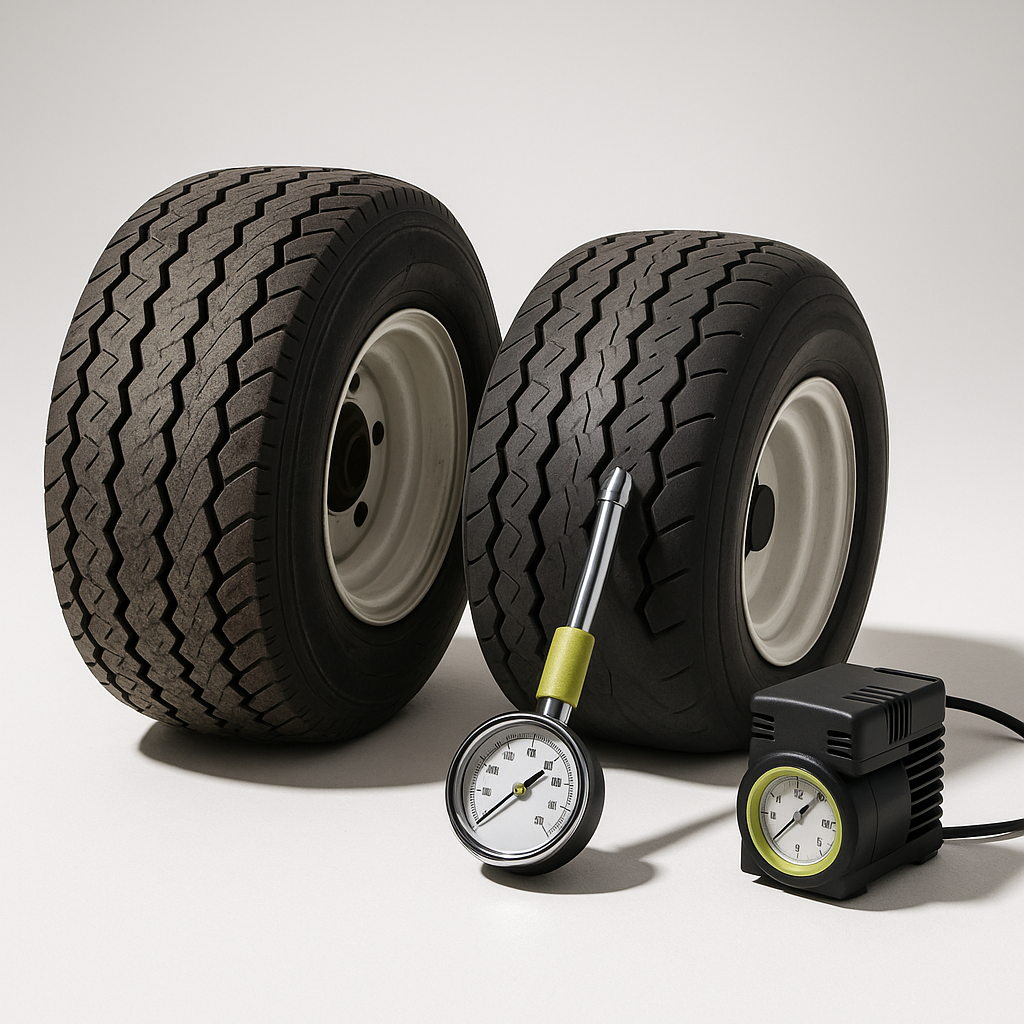
Golf cart tires run at much lower pressures than car tires, and small deviations matter more as a percentage of the total. Always check pressure when the tires are cold — not after driving, even a short distance. The recommended pressure is typically molded into the tire sidewall as a maximum, but your cart's owner manual or a sticker in the glove box area will give you the actual operating spec. If you don't have that reference, a modest, consistent pressure across all four tires is a reasonable starting point. The key is that all four should be equal. Pressure differences between tires on the same axle cause handling pull and accelerated wear on the lower-pressure side.
Diagnosing Slow or Recurring Air Loss
If a tire keeps going soft, there are four main culprits: a puncture in the tread, a leaking valve stem, a bead leak where the tire seats against the wheel, or a cracked or damaged rim. To find a puncture, inflate the tire fully and listen for hissing, then spray soapy water across the entire tread surface and sidewall — bubbles will appear at the leak point. Valve stem leaks are common on older carts; spray soapy water directly on the stem with the cap removed. Bead leaks are trickier — they show up as bubbles around the inner or outer edge of the rim and usually mean the tire needs to be dismounted, the bead area cleaned, and re-seated. Rust pitting or cracks in the rim itself can also allow air to escape slowly and won't be visible until the tire is off the wheel.
What Uneven Wear Tells You About the Chassis
Uneven wear isn't just a tire problem — it's a symptom of something upstream. One-sided wear on a front tire almost always points to a toe or camber alignment issue, which on golf carts is often caused by worn tie rod ends, a bent spindle, or a loose ball joint. If you grab the top and bottom of a front tire and rock it, any detectable play suggests a worn wheel bearing or ball joint. Grab it at the three and nine o'clock positions and rock it instead — play there usually indicates a tie rod or steering component problem. Rear tires wearing unevenly are less common since most golf carts have a solid rear axle, but they can indicate a bent axle, an overloaded cart that consistently carries weight on one side, or a tire that's been mounted off-center.
Checking the Wheels and Hubcaps
While you're inspecting, look at the wheels themselves. A bent or cracked wheel can cause chronic air loss, vibration at speed, and accelerated tire wear on one section of the tread. Spin each wheel slowly by hand with the cart jacked up — wobble or a visible waver indicates a bent rim. Also check that hubcaps and center caps are seated properly and aren't cracked. A loose or missing hubcap won't affect tire pressure, but it can obscure the lug nuts from view and make it easy to miss a wheel that's backing off its fasteners. If a hubcap is rattling or repeatedly popping off, inspect the retention clips or the inner mounting ring — these wear out over time and can usually be replaced without replacing the whole wheel.
When to Replace vs. Repair
A nail or screw in the center tread of a golf cart tire can often be plug-repaired just like a car tire, as long as the puncture isn't in the sidewall and the tire isn't structurally compromised. Sidewall damage, bulges, or deep cracking from UV exposure or age means the tire should be replaced — these aren't safely repairable. If your tires are heavily cracked across the sidewalls even without visible wear, that's age and ozone degradation. Golf cart tires can look like they have tread left while being well past safe service life. If you're seeing cracking throughout the rubber, plan on replacement regardless of tread depth.
Running through this diagnostic systematically will tell you whether your problem is the tire itself, the wheel, a mounting issue, or a chassis alignment problem — and that distinction matters a lot before you spend money on anything. A new set of tires on a cart with a worn tie rod end will wear out just as fast as the old set did.