If you've noticed one tire wearing faster than the others, or you're seeing odd wear patterns — bald edges, a bald center strip, cupping — your golf cart is trying to tell you something. Tires don't wear unevenly by accident. Something mechanical or maintenance-related is causing it, and if you ignore it long enough, you'll be replacing tires far more often than you should, and potentially dealing with handling or safety problems in the meantime. The good news is that most causes are diagnosable without specialized equipment, just a little time and a critical eye.
Start With Tire Pressure
Low or uneven tire pressure is the single most common cause of abnormal tire wear on golf carts, and it's also the most overlooked. Running a tire underinflated causes the outer edges of the tread to carry the bulk of the load, which wears the shoulders down while the center stays relatively untouched. Overinflation does the opposite — the tire crowns in the middle and only the center strip contacts the ground. Check all four tires with a gauge and inflate them to the manufacturer's recommended pressure, which is usually molded into the sidewall as a maximum and specified in your owner's manual as the correct operating range. Do this check when the tires are cold, before driving. If one tire consistently loses pressure faster than the others, you may have a slow leak — inspect the valve stem, the bead seal, and the sidewall for damage.
Look at the Wear Pattern Itself
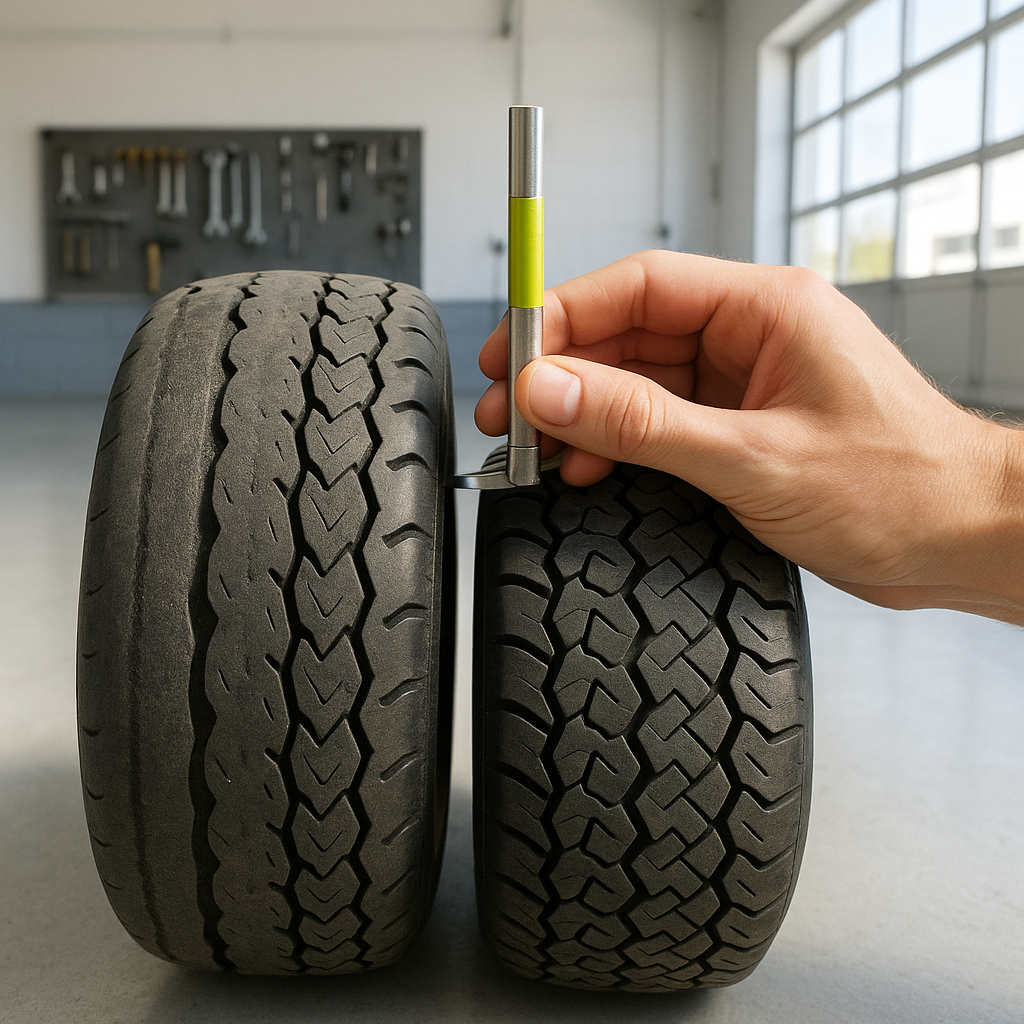
Before you do anything else mechanically, crouch down and look at each tire carefully. The wear pattern gives you a lot of diagnostic information. Wear on both outer edges but not the center points to underinflation. Wear only in the center points to overinflation. Wear on just one edge — inner or outer — usually indicates an alignment problem, specifically camber (the lean of the wheel relative to vertical). Cupping or scalloping, where the tread looks wavy or has dips worn into it, often points to a wheel balance issue or worn suspension/steering components. Take notes on which tire is affected and where the wear is occurring — it will help you narrow down the root cause quickly.
Check for Alignment Issues
Golf carts — especially those that have been lifted, have seen rough terrain, or have had front-end work done — can develop alignment problems that destroy tires quietly and quickly. The two main alignment variables that affect tire wear are toe and camber. Toe refers to whether the fronts of the tires point inward (toe-in) or outward (toe-out) relative to each other. Incorrect toe causes a scrubbing wear pattern that can look like feathering on the tread blocks when you run your hand across them. Camber refers to whether the wheel leans inward or outward at the top. Excessive camber wears one edge of the tire heavily. A visual inspection can catch severe misalignment — stand in front of the cart and look down the front axle. But subtle misalignment often requires a string line or a professional alignment check to confirm. If you've recently installed a lift kit or new spindles and tire wear problems started after that, alignment is the first place to look.
Inspect Wheel Bearings and Suspension Components
Worn wheel bearings can cause a wheel to develop play or wobble at speed, which leads to irregular, cupped tire wear over time. To check a wheel bearing, jack up the cart safely so the tire clears the ground, then grab the tire at the 9 and 3 o'clock positions and try to rock it side to side. Then grab it at 12 and 6 and do the same. Any perceptible looseness or knocking indicates a worn bearing. While the wheel is off the ground, spin it by hand and listen for grinding or roughness — that's also a bearing symptom. While you're at it, inspect the tie rod ends and any bushings or ball joints in the front suspension for play or deterioration. Loose or worn steering and suspension components allow the wheel to move in ways it shouldn't, and tires pay the price.
Consider Your Driving Surface and Habits
Not all uneven wear is caused by a mechanical fault. If your cart mostly turns in one direction — think a course or community where you're constantly looping the same way — the tires on the inside of those turns will work harder and wear faster. Driving frequently on rough, uneven terrain, gravel, or steep slopes also accelerates wear unevenly depending on how the load transfers. This kind of wear is harder to prevent entirely, but rotating your tires periodically — swapping fronts to the rear and vice versa — helps even out the wear across all four tires and extends the overall life of the set.
When to Replace vs. Repair
If you catch the underlying cause early enough, you may be able to correct it and get useful life out of the remaining tread on your current tires. But if a tire has already worn down significantly on one edge or developed structural damage from running low, replacement is the right call — continuing to drive on a badly worn tire is a safety risk, particularly on carts that carry passengers or operate on roads and slopes. Once you've identified and corrected the root cause, put fresh tires on and start from a clean baseline. Then check your tire pressure monthly and inspect tread wear every few months so you catch any recurrence early.