Installing a lift kit is one of the most common modifications golf cart owners make, and for good reason — more ground clearance opens up rougher terrain and allows for larger tires. But a lift changes your cart's suspension geometry, center of gravity, and steering angles all at once. When handling problems show up afterward, it's not always obvious which of those changes is responsible. This guide walks you through the most common culprits in a logical order so you're not guessing.
Start by Defining the Problem Precisely
Vague handling problems are hard to diagnose. Before you get under the cart, take it for a slow test drive and answer these questions: Does the cart feel unstable at speed, or is it a steering input problem? Does it wander on its own, or only when you hit a bump? Does it feel like the front end is floating, or is there a pulling sensation to one side? Does the problem get worse when turning, or is it consistent going straight? The more precisely you can describe what's happening, the faster you'll identify the cause. Write it down if it helps.
Check the Lift Hardware First
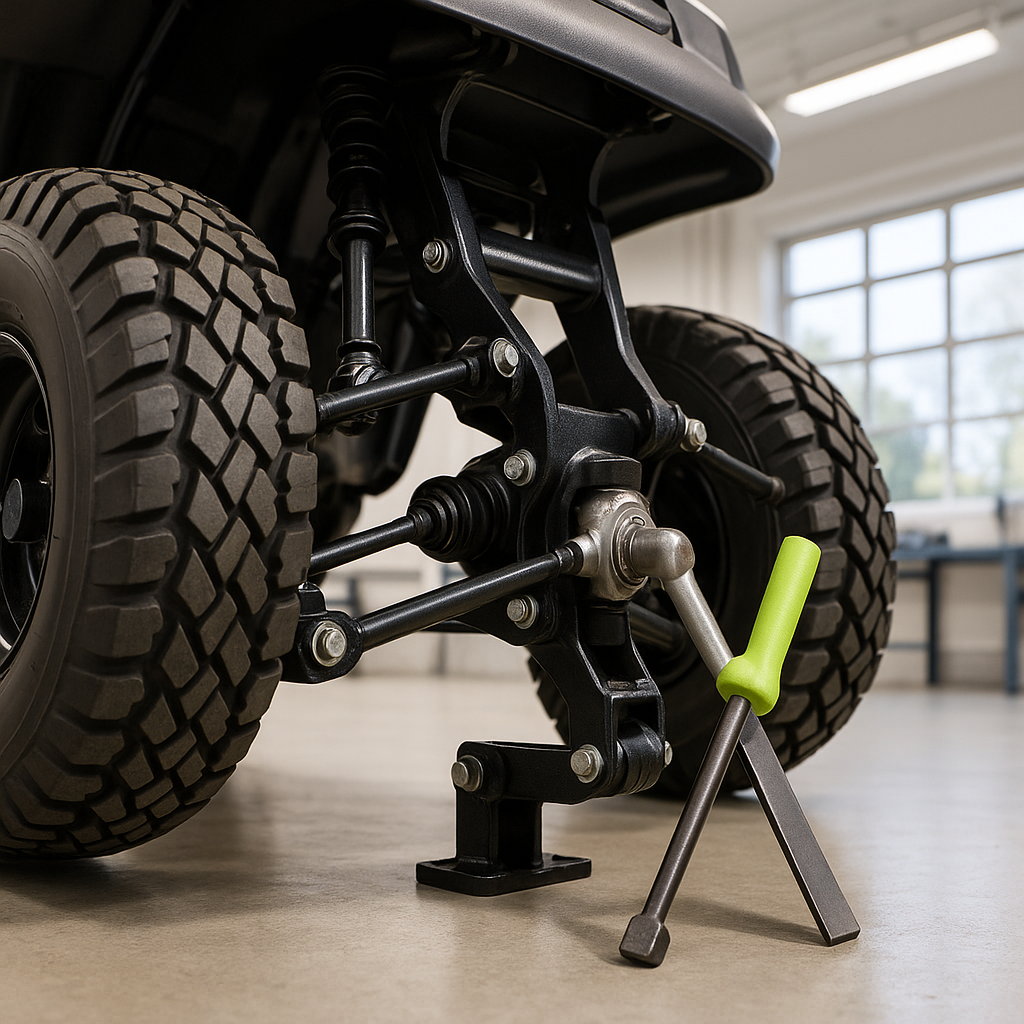
The most overlooked step after a lift installation is a thorough hardware re-check a few weeks in. Lift kit hardware — spindles, A-arm brackets, drop brackets, and all associated fasteners — can settle and loosen after the first several hours of use. Get the cart on a flat surface and work through every bolt and connection point in the lift system. Any looseness here will translate directly into unpredictable handling, wandering, or a feeling that the front end isn't tracking straight. If you find loose hardware, torque everything to spec and re-test before moving on.
Inspect Wheel Alignment and Toe Setting
A lift kit almost always moves the front wheels out of their factory alignment settings. Toe — the angle at which the front wheels point inward or outward relative to each other — is particularly sensitive to suspension height changes. Too much toe-out causes the cart to feel darty and nervous; too much toe-in makes steering feel heavy and can cause the cart to resist turning. Both produce tire wear that looks like feathering or scrubbing on the inner or outer edges. Alignment is something many owners skip after a lift, assuming it's handled automatically — it isn't. A basic toe check can be done with a tape measure and a straight edge, or a shop can dial it in properly.
Look at Camber and Spindle Angles
Beyond toe, the camber angle — how much the top of the wheel leans in or out — changes with lift height. Some lift kits include corrected-geometry spindles or A-arms specifically to compensate for this; others don't. If your kit didn't include geometry-corrected components, there's a good chance your camber is now outside of an acceptable range. Visible signs include tires that look noticeably tilted when viewed from the front of the cart, or rapid wear on one edge of the tire tread. Significant camber issues usually require corrective spindles or adjustable components — they can't be shimmed away with a basic alignment.
Evaluate Steering Linkage Stretch and Bind
When you raise the suspension, the angles of the tie rods and steering linkage change. In some configurations, this means the tie rods end up working at a steeper angle than they were designed for, which can create bump steer — a sensation where the cart wants to turn by itself when going over rough ground, even with your hands steady on the wheel. Check the tie rod ends for excessive play by grabbing each wheel at the three and nine o'clock positions and rocking it side to side. Any clunking or looseness at the tie rod ends points directly to a steering linkage issue that will make the cart feel unpredictable.
Assess Tire Size and Weight Distribution
A lift kit is usually paired with larger tires, and larger tires have their own effect on handling. Heavier, taller tires raise the center of gravity further and increase the rotational mass at the wheel — both of which make the cart feel less planted, particularly in corners. If the tires are too wide for the cart's track width, or if the wheels push the tires significantly outboard of the fender line, handling and stability will suffer. Check that the tires clear the fenders through the full range of suspension travel, and that the offset of your wheels isn't placing undue stress on the wheel bearings and spindles.
When to Stop DIYing and Get Professional Help
If you've gone through all of these checks — hardware tightness, alignment, camber, steering linkage, and tire fitment — and the cart still doesn't handle predictably, it's worth having a shop look at it. Significant geometry problems, bent components from an off-road impact, or lift kits that simply aren't matched to the cart's chassis can produce handling issues that are genuinely difficult to fix without a lift, proper measuring tools, and experience. A handling problem that makes the cart feel unsafe at any speed isn't something to drive through and monitor — it needs a resolution before you put more miles on it.