A golf cart that runs fine on flat ground but falls apart the moment it hits a slope is one of the most common — and most misdiagnosed — problems in electric cart ownership. The symptom feels dramatic: the cart slows to a crawl, the motor strains audibly, or the cart shuts down entirely under load. Before you assume the worst, work through a systematic diagnosis. Most causes are well-established and fixable without replacing every major component at once.
Start With the Battery Pack
Under-load power loss is the single most common sign of a weak battery pack. Batteries that read a reasonable voltage at rest can collapse dramatically the moment real current demand hits — like climbing a grade. Check your individual cell voltages under load, not just at rest. If one or more batteries drop significantly below the others during acceleration or hill climbing, you've found a weak cell dragging down the whole pack. Also confirm your water levels in flooded lead-acid batteries and look for any cells that are bulging, cracked, or running unusually hot after a ride. A pack with even one bad battery will produce exactly this symptom.
Check Your Battery Connections and Cable Condition
High-resistance connections cause voltage drop that shows up worst under load. Inspect every battery terminal, every cable lug, and every connector in the main power circuit. Look for corrosion, loose nuts, cracked insulation, or cables that feel warm or hot after a short ride. A connection that looks clean on the surface can still have hidden resistance — if in doubt, clean the terminals, retighten, and retest. Also trace the main cables for any sections where insulation has worn through and the cable may be rubbing on the frame, creating an intermittent short under vibration.
Inspect the Motor
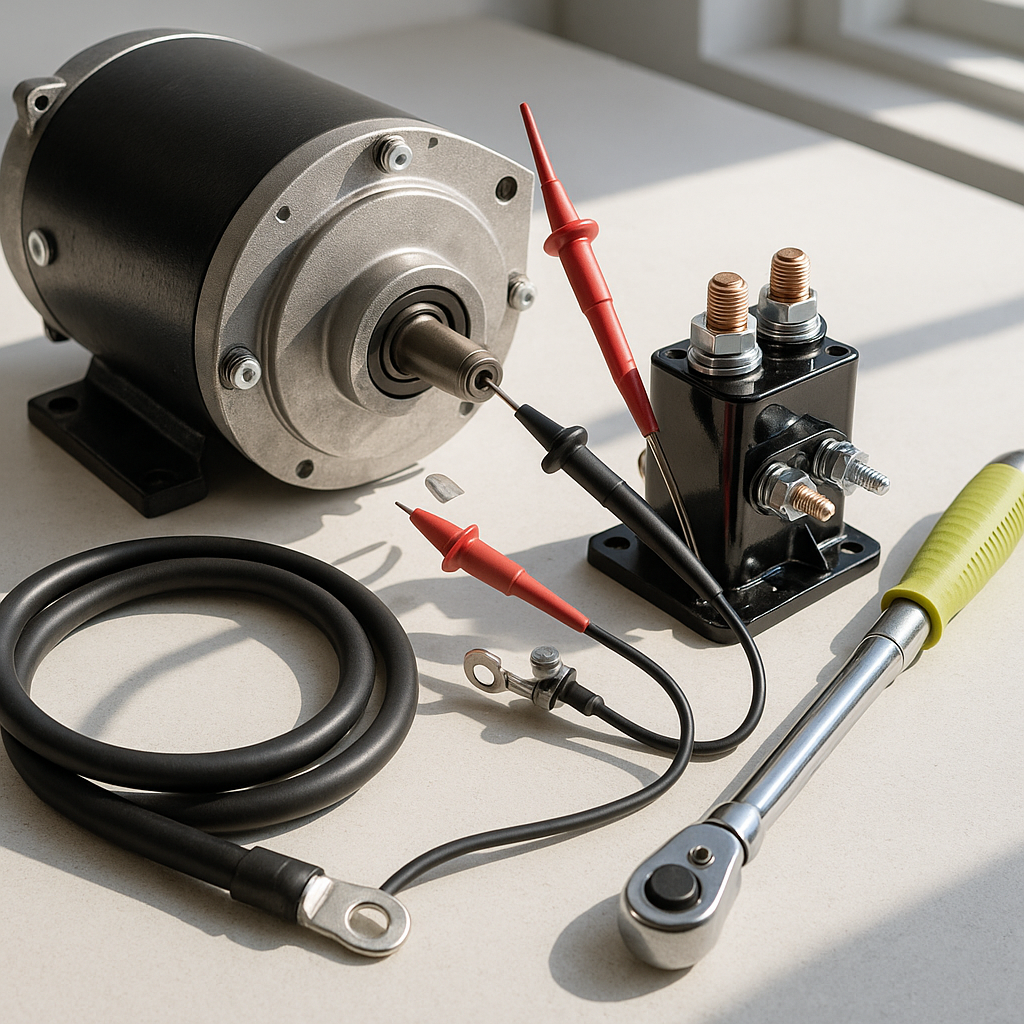
A worn or dirty motor will produce full speed on flat ground but struggle the moment torque demand increases. On series-wound DC motors — the most common type in older carts — worn brushes are a frequent culprit. Check brush length and spring tension if you're comfortable opening the motor end cap. Heavy carbon buildup on the commutator can also cause arcing and power loss under load. If you hear a new grinding, buzzing, or burning smell when the cart labors uphill, the motor is a serious candidate and deserves a closer look before you chase controller problems.
Test the Controller
The motor controller is the brain that regulates how much current reaches the motor. When a controller is failing or working outside its design parameters, load-dependent power loss is a classic symptom — the controller may be going into a protection mode (thermal cutback, current limiting, or low-voltage shutoff) that only triggers when real demand hits. If the cart cuts out completely on hills but then recovers after sitting for a minute, thermal protection is a strong suspect. Controllers that are undersized for the load, improperly mounted with poor heat dissipation, or simply aging will do exactly this. Check that the controller's heatsink is clean, unobstructed, and properly making contact with its mounting surface. Fault codes, where supported by your cart's system, can also point directly at the issue.
Check the Throttle Sensor or Pedal Assembly
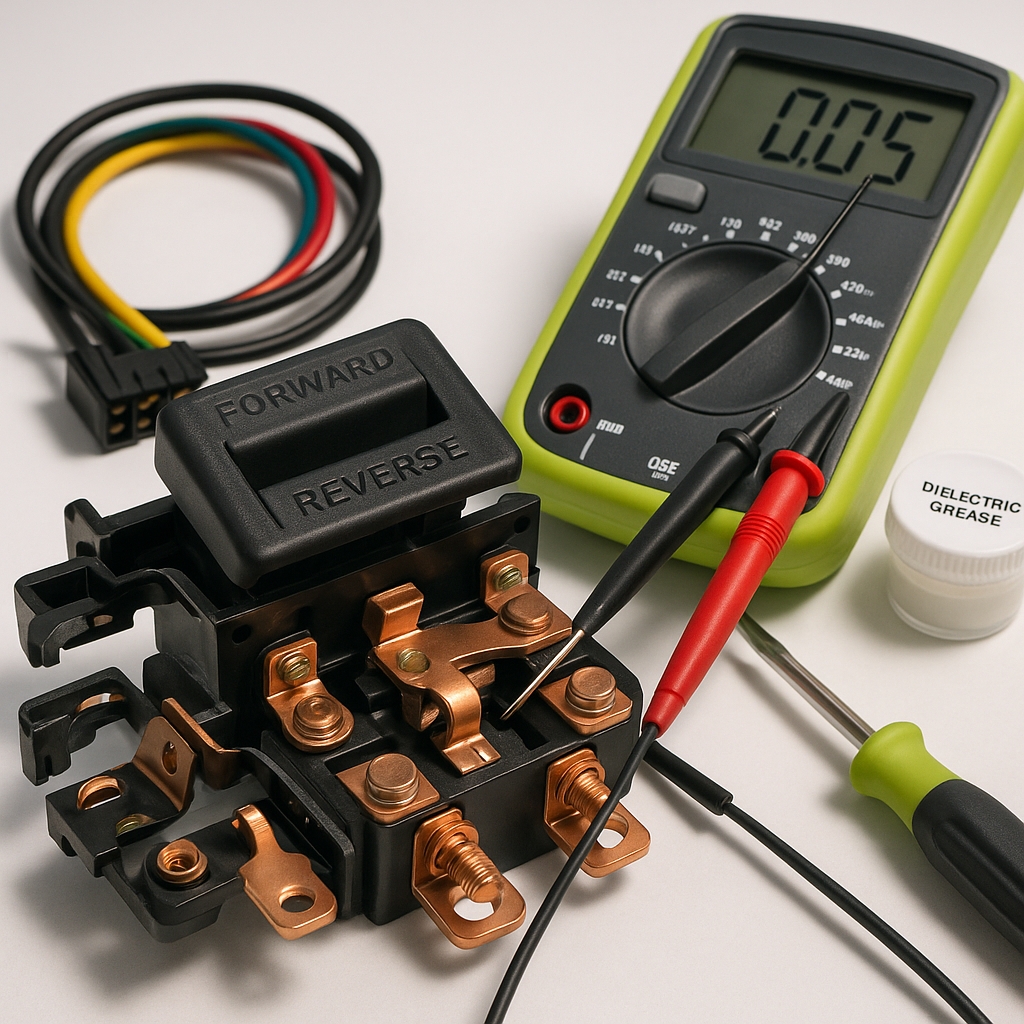
An inductive throttle sensor or potentiometer that's worn at the high-demand end of its travel range can cause the controller to receive an incorrect signal precisely when you're pressing the pedal hardest — like going uphill. If the cart feels like it hesitates, surges, or hits a ceiling under load rather than cutting out cleanly, this is worth testing. With a multimeter, check that the sensor output sweeps smoothly and linearly through its full range without dead spots or drop-outs at full pedal travel.
Look at the Solenoid
A solenoid with pitted or corroded contacts will pass enough current for normal flat-ground operation but introduce significant resistance under the higher current draw of hill climbing. If you've ruled out batteries and connections, pull the solenoid and inspect the contact pads. Heavy pitting, burning, or carbon buildup on the contact faces is a reliable sign the solenoid is contributing to your voltage drop under load. This is a relatively inexpensive fix compared to the components it might otherwise lead you to replace unnecessarily.
Work Through It Systematically
The key to diagnosing load-dependent power loss is testing under the actual conditions that produce the symptom — ideally with a voltmeter connected so you can watch voltage behavior in real time during a hill climb or hard acceleration. Catching a voltage collapse in the moment tells you far more than any at-rest measurement. Start with batteries, move to connections, then motor condition, then controller behavior. Most carts with this symptom turn out to have a battery or connection issue rather than a failed controller — but when the controller is genuinely the problem, identifying it correctly saves you from replacing components that didn't need it.