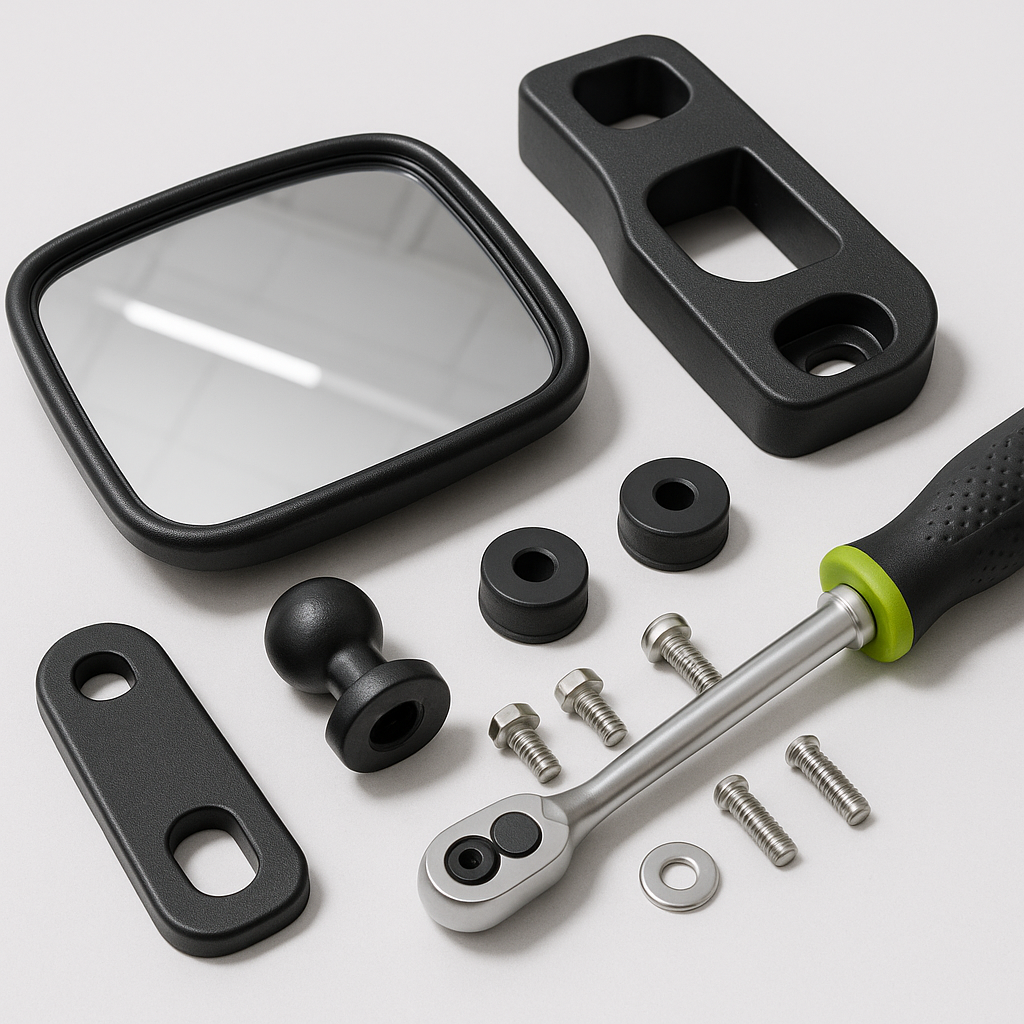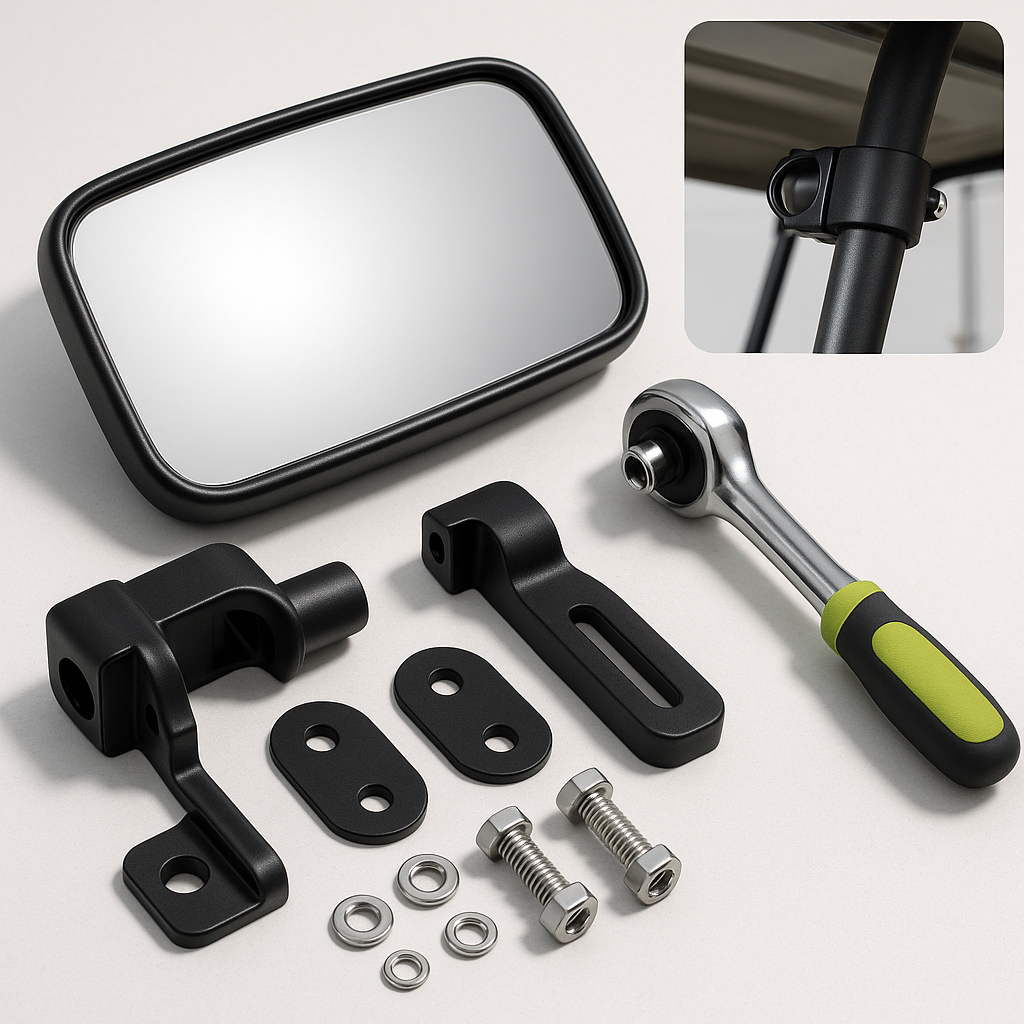
A golf cart mirror that vibrates, shakes, or goes blurry while you're moving isn't just annoying — it defeats the entire purpose of having one. If you can't get a clear view behind you at normal driving speeds, your mirror might as well not be there. The good news is that mirror vibration is almost always a mechanical issue with a straightforward cause, and you can usually track it down in a few minutes without any special tools.
Start With the Mount Point
The most common cause of mirror vibration is a loose connection at the mounting point — where the mirror attaches to the windshield frame, roof strut, or dash. Over time, vibration from the cart itself works fasteners loose, especially on carts that see regular use on rough terrain. Before assuming anything else is wrong, get your hands on the mirror bracket and try to wiggle it by hand. If there's any play between the bracket and the surface it's mounted to, tighten those fasteners first. Even a small amount of looseness at the base gets dramatically amplified at the mirror face, especially at the outer edge of a wide rearview mirror.
Check the Mirror Arm or Stem
Many golf cart mirrors use an adjustable arm or stem that allows you to position the mirror head. These joints are designed to hold a position, but they can wear out or lose tension over time. If the arm itself flexes or wobbles under light pressure, that's your problem. Some arms have a tightening screw or nut at the pivot point — check whether tightening it reduces movement. If the arm is bent or the pivot hardware is stripped or corroded, the arm itself may need to be replaced rather than adjusted. A bent arm that looks straight at rest can still flex significantly at speed.
Look at Where Vibration Is Coming From
Not all mirror vibration originates at the mirror. Sometimes the surface the mirror is mounted to — a thin windshield frame, a hollow roof strut, or a plastic dash panel — is itself resonating at certain speeds. Press your hand firmly against the mounting surface while someone else drives slowly, and feel whether the vibration is coming through the cart structure rather than from the mirror hardware. If so, you may need to mount to a stiffer location, add a backing plate behind thin panels to distribute the load, or use rubber-dampening hardware between the bracket and the mounting surface.
Inspect the Mirror Head Itself
The mirror glass or lens is typically held in a plastic or die-cast housing. If the glass has worked loose inside the housing — which can happen after impacts or long-term vibration — it will buzz and shimmer even if the mount is solid. Check whether the mirror face has any play inside its housing by gently pressing on the edges. Some housings have a retaining clip or bezel that can be re-seated; others may require replacing the mirror head assembly if the internal fit has worn out. Also look for any cracks in the housing itself, since a cracked frame loses rigidity and will flex under airflow.
Consider Aerodynamic Buffeting
At higher speeds — especially on open stretches or when wind is coming from the side — flat mirror faces can catch enough airflow to vibrate even when everything is mechanically tight. This is more common with large flat rearview mirrors mounted high on the windshield or roof. If your mirror is solid when the cart is stationary but develops a flutter specifically at speed, aerodynamic buffeting may be a factor. Angling the mirror slightly differently can sometimes reduce the profile it presents to oncoming air. Mirrors with a slight convex curve tend to be less susceptible to this than completely flat glass.
When It's Time to Replace Rather Than Adjust
If you've tightened every fastener, confirmed the mount surface is solid, and the mirror arm and head have no obvious play — but the mirror still vibrates — the hardware has likely fatigued past the point where adjustment will hold. Mirror arms and brackets are wear items, especially on carts used on gravel paths, cart paths with expansion joints, or any surface that generates regular chassis vibration. Replacing a worn mirror assembly with a new one that has tight pivot hardware will solve the problem more reliably than continued tightening of worn threads or stretched pivot joints. When shopping for a replacement, prioritize mounts with metal-to-metal contact at the pivot and robust bracket materials over lightweight plastic-only assemblies.