Upgrading your golf cart's mirrors or steering wheel is one of the most visible and practical improvements you can make — but walk into any parts search and you'll quickly find a wide range of quality levels, fitment types, and construction that can make the decision confusing. Before you spend money on either category, it pays to understand what separates a solid upgrade from something that'll rattle loose or fog up after a season. This guide breaks down the real criteria worth evaluating.
Mirror Fitment: Universal vs. Brand-Specific
The single most important thing to check before buying any golf cart mirror is fitment compatibility. Some mirrors are designed specifically for Club Car, EZGO, or Yamaha frames and clamp directly to existing tubing or mounting points with minimal fuss. Others are marketed as universal fit, which means they rely on adjustable clamps to grip round tubing of various diameters. Universal mirrors can work perfectly well, but you need to confirm your roof strut or windshield frame tubing diameter actually falls within the clamp's range — and that the clamp material is robust enough to hold firm on the road without vibrating loose. Brand-specific mirrors tend to offer a cleaner install and a more secure hold, so if your cart is a known make and model, prioritize purpose-fit options when they're available.
What to Look for in Mirror Construction
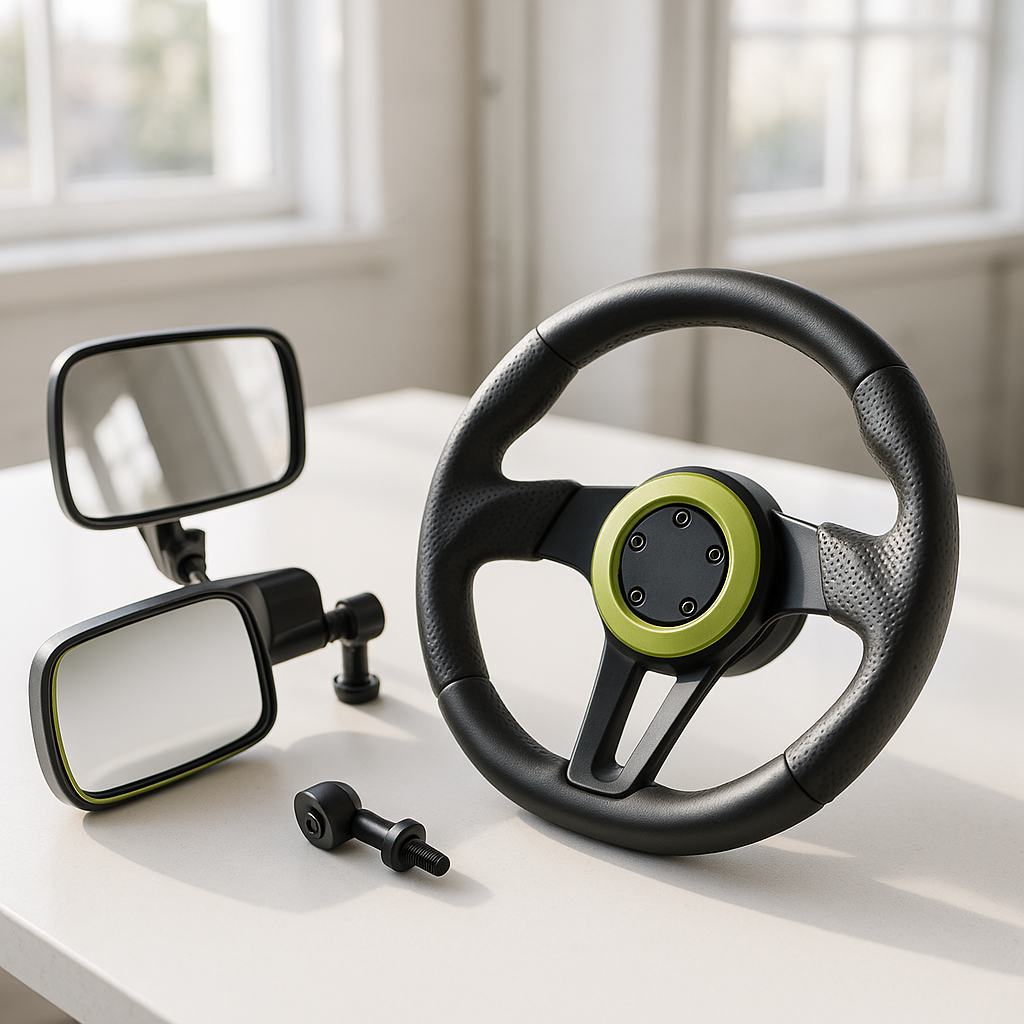
Mirror housing material matters more than it might seem. UV-exposed plastic housings can crack and fade quickly in direct sun, especially in hot climates. Look for mirrors described as UV-resistant or those with a housing made from ABS or similar impact-resistant plastic. The mirror glass itself should be shatter-resistant — some use acrylic or tempered glass, both of which are preferable to standard glass on a vehicle that may encounter trail debris or tight garage clearances. A wide-angle or convex mirror face gives you significantly better rear visibility than a flat glass equivalent, which is especially important on carts that don't have a traditional rearview mirror setup. Also check that the mounting hardware is corrosion-resistant, since most carts spend a lot of time outdoors.
Rearview vs. Side Mirrors: Do You Need Both?
Many golf cart setups rely on a single center-mounted rearview mirror, which is fine for open course use but limiting for street-legal carts, neighborhood vehicles, or carts used on multi-use paths. If you're driving on public roads or in areas with cross traffic, side mirrors provide coverage that a rearview mirror simply can't. A practical setup for street-legal use is a combination of both — a wide rearview mirror mounted to the roof or windshield frame, plus a pair of side mirrors mounted to the front uprights or windshield posts. Some carts require specific mounting adapters to achieve this cleanly, so check what's needed for your frame before committing to a full mirror package.
Steering Wheel Fitment and Hub Adapter Compatibility
Steering wheels are where fitment gets more technical. Golf cart steering wheels use a splined or keyed shaft connection at the hub, and the pattern and diameter of that connection varies by manufacturer and model year. Most aftermarket steering wheels require a separate hub adapter to mate the wheel to your specific cart's steering column — and this is the piece that absolutely must be correct for your make, model, and year. A wheel that fits an EZGO won't necessarily fit a Club Car without the right adapter. Before shopping for the wheel itself, identify your exact cart make, model, and year, then confirm what hub adapter is required. Buying a wheel without solving the hub question first is the most common fitment mistake in this category.
Steering Wheel Materials and Ergonomics
Standard golf cart steering wheels are functional but basic — often a simple plastic rim with limited grip texture. Aftermarket options typically offer a wrapped or overmolded grip in materials like leather, synthetic leather, or soft-touch rubber, which meaningfully improves comfort on longer rides. Diameter is worth thinking about too: a smaller-diameter wheel generally gives a more responsive, sporty feel, while a larger diameter is easier to turn at low speeds without power steering. For lifted or modified carts with heavier steering, a larger diameter can reduce fatigue. Check the spoke count and construction as well — three-spoke designs tend to be stiffer and lighter than four-spoke equivalents, though either works fine for typical cart use.
What's Typically Included — and What's Not
When evaluating any mirror or steering wheel listing, pay close attention to what's actually in the box. Mirrors are sometimes sold individually rather than as a pair, and mounting hardware may or may not be included. Steering wheels are almost universally sold without a hub adapter — that's a separate purchase. Some mirror kits include mounting hardware and a center bolt; others assume you're reusing existing hardware. Reading the product description carefully and checking customer photos for real-world install references will save you a frustrating return. If a listing isn't clear about what's included, treat that as a red flag about overall product documentation and support quality.
Final Check Before You Buy
Run through these before purchasing: Does this fit my specific cart make, model, and year? Is mounting hardware included or do I need to source it separately? For mirrors — is the clamp range compatible with my tubing diameter? For steering wheels — do I have the correct hub adapter on order? Is the material appropriate for outdoor use in my climate? A few minutes of verification upfront is the difference between an upgrade that looks and works great and one that sits in a box waiting on a part you didn't know you needed.