Installing a lift kit raises your golf cart's center of gravity and fundamentally changes how the suspension and steering geometry behave. A small amount of additional body movement compared to stock is expected — but if your cart is bouncing hard over every bump, wandering all over the path, or feeling genuinely unsettled at normal speeds, something is wrong. The good news is that most rough-ride complaints after a lift come down to a short list of checkable causes, and you don't need special equipment to work through most of them.
Start With Tire Pressure and Tire Condition
This sounds basic, but it's the most commonly skipped step. Lifted carts almost always run larger tires, and those tires are extremely sensitive to pressure. Over-inflated tires on a lifted cart will transmit every pebble straight through the frame. Under-inflated tires cause their own wallowing, squirmy feel. Check your tire pressure against the sidewall maximum and the manufacturer's recommendation for your tire size — not what the old smaller tires ran. Also look at the tires themselves: uneven wear, flat spots from sitting, or feathering across the tread can all cause vibration and rough tracking that gets amplified by the taller ride height.
Check Every Lift Kit Fastener for Torque
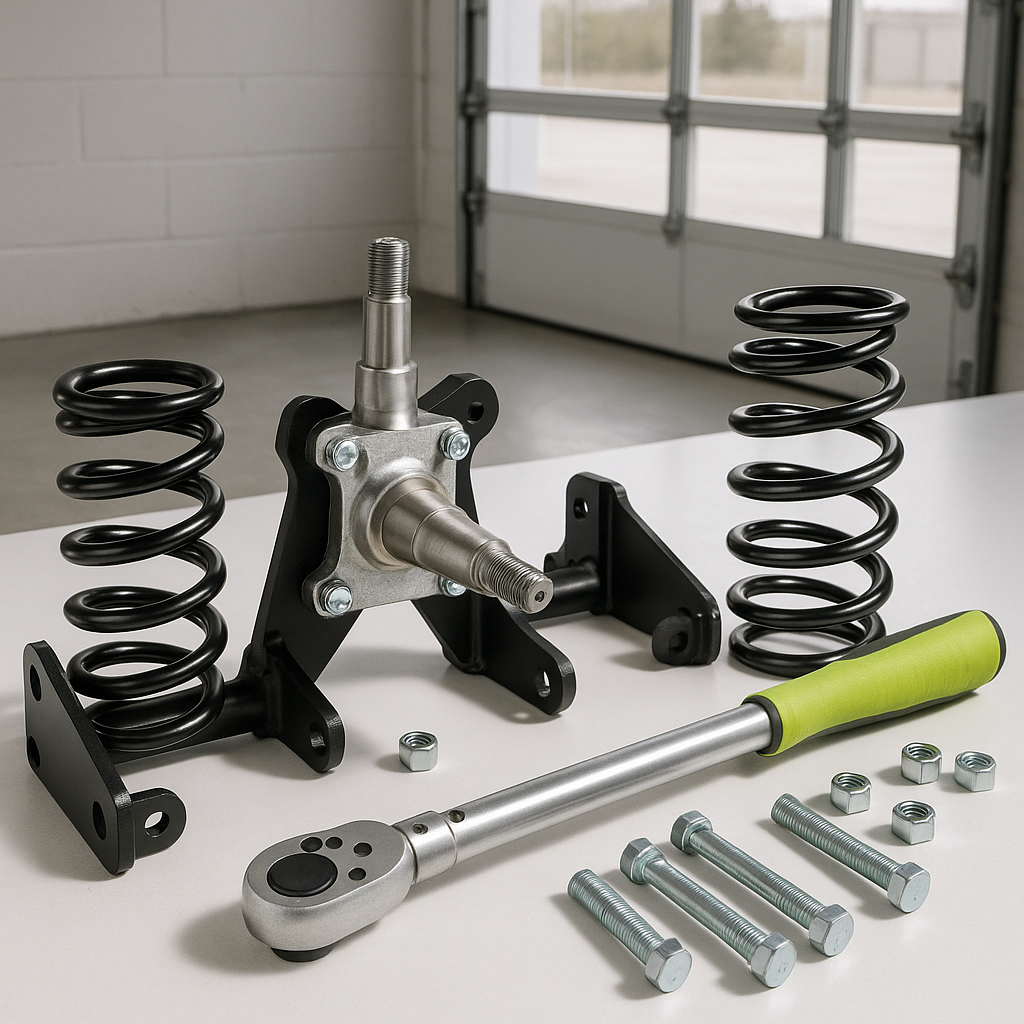
Loose hardware is one of the most common causes of a rough, clunky ride after a lift install — and it's often overlooked because everything looked tight during installation. Over the first several rides, fasteners can settle and work loose, especially on A-arm bolts, spindle hardware, and any block or spacer connections. Go back through every bolt in the lift system with a wrench. You're not looking to crank them down harder than spec — you're checking for anything that has visibly backed off or that turns without resistance. A loose connection anywhere in the suspension translates directly into harshness and noise.
Inspect the Shocks or Shock Mounts
Many lift kits relocate or replace the factory shock absorbers, and problems here are a leading cause of a punishing ride. Grab each shock and try to move it by hand — there should be no lateral slop at either the upper or lower mount. Worn or cracked bushings at the mount points allow the shock to move in ways it shouldn't, creating a harsh clunking sensation over bumps. If your lift uses aftermarket shocks, compress each one slowly by hand: resistance should be smooth and consistent through the full stroke. Any binding, dead spots, or a shock that collapses with almost no resistance indicates a failed unit that needs replacement.
Look at Your Leaf Springs or A-Arms for Damage
Lifts that use lift blocks under the leaf springs (common on many rear axle setups) can introduce axle wrap under acceleration and braking, which feels like a rhythmic lurch or hop. Check that lift blocks are seated squarely, that the U-bolts clamping them are tight, and that the spring itself hasn't cracked — a cracked leaf spring is a safety issue, not just a comfort one. On independent front suspension setups using A-arm lifts, check the arms for any visible bending or cracks at the welds, and make sure all pivot bushings are in good condition with no tearing or collapse.
Evaluate Your Wheel and Tire Combination for Balance
Larger wheels and tires added with a lift kit are almost never balanced at the time of installation on golf carts — it's just not standard practice the way it is with cars. But an unbalanced wheel-and-tire assembly causes noticeable vibration that gets worse the faster you go. If your cart feels smooth at very low speeds but increasingly rough and buzzy at higher speeds, wheel balance is the likely culprit. A tire shop can balance golf cart wheels just like automotive ones. Also check each wheel for runout — a bent rim from a curb strike will create a rhythmic thud that no amount of balancing will fix.
Assess Steering and Alignment After the Lift
Lifting a golf cart changes the steering geometry. If toe, camber, or caster are now outside of reasonable range and haven't been corrected, you'll experience a cart that feels twitchy, darts, or requires constant correction — all sensations that drivers describe as a rough or unstable ride even when the suspension itself is fine. Look at your front tires from directly in front of the cart: the tops should be roughly vertical, not dramatically angled in or out. From above, the tires should point reasonably straight ahead, not visibly toed in or out at rest. Significant deviation in either direction means alignment needs to be addressed, which often involves adjustable tie rod ends or camber correction components designed for lifted setups.
When to Stop DIY Diagnosing
If you've worked through all of the above and the ride is still harsh or the handling feels unsafe, get the cart to a shop before continuing to drive it. Suspension components that are cracked, severely worn, or incorrectly installed can fail unexpectedly — and a lifted cart that loses a wheel or a control arm at speed is a serious hazard. A rough ride after a lift is almost always fixable, but the right fix depends on correctly identifying the actual cause rather than replacing parts at random.