When a golf cart solenoid clicks, it's actually doing its job — closing a circuit to let power flow to the motor. A cart that clicks but won't move is one problem. A cart where the solenoid makes no sound at all when you press the accelerator is a different problem entirely, and it tells you something specific: the solenoid coil either isn't receiving the signal it needs to fire, or the solenoid itself has failed internally. Working through this systematically will tell you which one it is before you replace anything.
Start With the Basics: Battery Voltage and Connections
A solenoid that won't click is almost always a power or signal problem upstream. Before testing the solenoid itself, confirm your battery pack is adequately charged and that your main battery connections are clean and tight. Low voltage — even if the cart technically turns on — can prevent the solenoid coil from generating enough magnetic force to pull the plunger and make contact. Check the main positive and negative cables at the battery pack and at the solenoid terminals for corrosion, looseness, or heat damage. A green or white chalky buildup at any terminal creates resistance that kills voltage before it ever reaches the coil.
Understand How the Solenoid Gets Its Signal
On most electric golf carts, the solenoid coil is triggered by a low-voltage control circuit — not directly by the battery pack voltage. That control signal typically comes through a chain that includes the key switch, the forward/reverse switch, and in many cases a microswitch under the accelerator pedal. If any link in that chain is broken or faulty, the solenoid coil never gets energized and will stay completely silent. This is why a dead solenoid symptom is often not a solenoid problem at all.
Test the Key Switch and Forward/Reverse Switch First
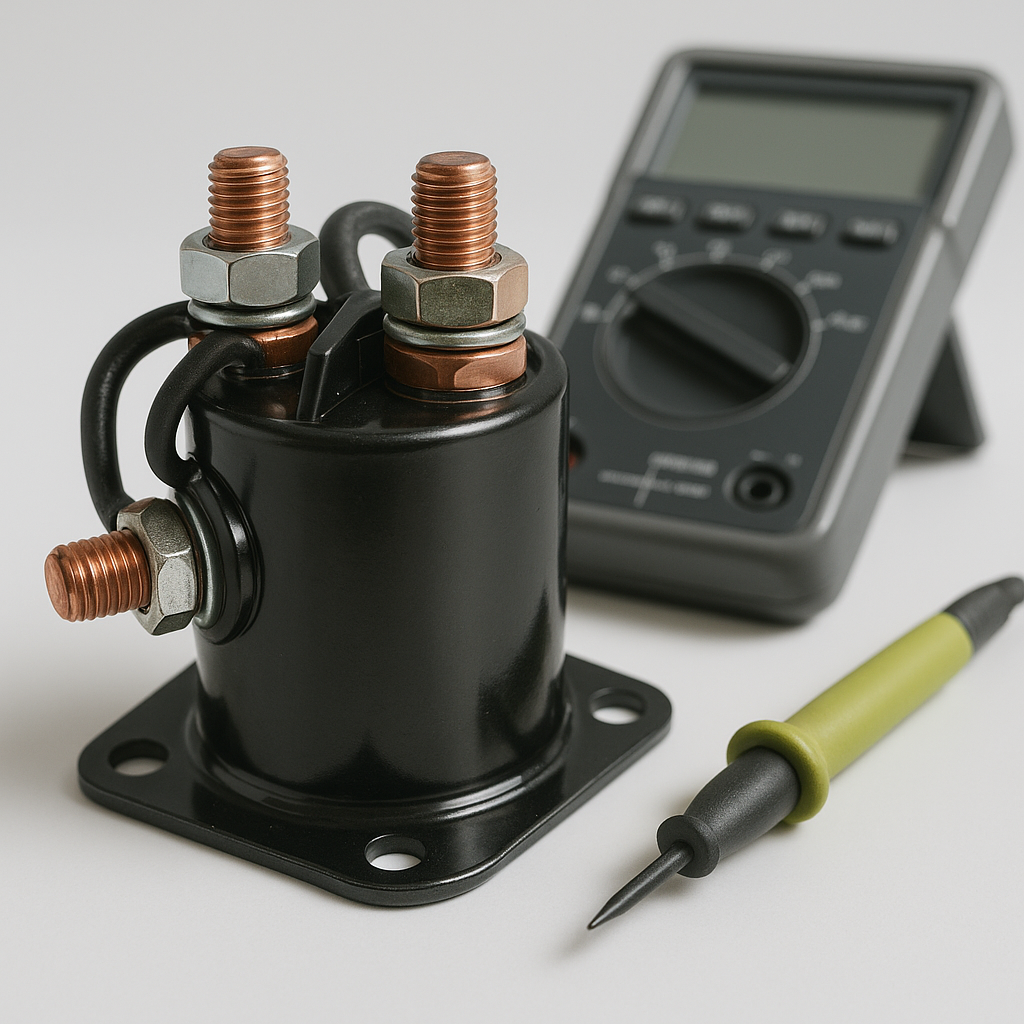
With the cart in a safe position and the key on, use a multimeter set to DC voltage. Probe the small control terminals on the solenoid — these are the low-voltage trigger wires, separate from the large main power lugs. You should see voltage at those terminals when the key is on, a direction is selected, and the accelerator is pressed. If you see nothing at the control terminals, trace back toward the key switch and the forward/reverse switch. A failed key switch is surprisingly common and will kill the entire control circuit. The forward/reverse switch can also fail internally, especially on older carts, breaking the control signal path even when the switch physically moves.
Check the Accelerator Microswitch
Many golf carts use a small microswitch at the top of the accelerator pedal travel that must close before the solenoid receives its trigger signal. This switch is a common failure point — it can wear out, corrode, or simply fall out of adjustment so it never fully closes. With the key on and a direction selected, have someone slowly press the accelerator while you watch or listen for any response from the solenoid. If the solenoid stays silent through the full pedal range, check whether this microswitch is clicking mechanically and whether it's passing voltage when pressed. On ITS/speed sensor systems the logic is handled differently, but a failed throttle position sensor or inductive pickup can produce the same no-signal result.
Test the Solenoid Coil Directly
Once you've confirmed the control circuit is actually delivering voltage to the solenoid's small terminals and it still won't click, the solenoid coil itself is likely burned out or open. You can verify this with a multimeter on resistance mode: disconnect the coil wires and measure across the two small terminals. A working coil will show some resistance — an open reading (infinite resistance) means the coil winding has failed and the solenoid needs replacement. Some technicians also do a quick bench test by applying the correct control voltage directly to the coil terminals while the solenoid is off the cart; a good solenoid will click audibly and the plunger will engage.
Don't Overlook Ground Connections
A solenoid coil needs a complete circuit — signal voltage in and a solid ground path out. A broken or corroded ground wire on the solenoid or elsewhere in the control circuit can cause a no-click symptom even when the incoming signal voltage looks fine. Check the ground side of the solenoid coil wire back to its chassis or battery negative connection. On carts with corrosion history or rodent damage, a compromised ground is often the culprit that gets missed.
When to Replace vs. Keep Diagnosing
Replace the solenoid when you've confirmed the control circuit is delivering proper voltage to the coil terminals and a resistance test shows an open or shorted coil. If the coil tests fine but still won't click under power, double-check your voltage reading is at the correct specification for your system — installing a 36V solenoid in a 48V cart (or vice versa) will cause exactly this symptom. If you replace the solenoid and the new one also won't click, the problem is definitively upstream in the control circuit, not the solenoid — don't keep replacing parts. Trace the signal path methodically from the key switch forward until you find where voltage drops out.