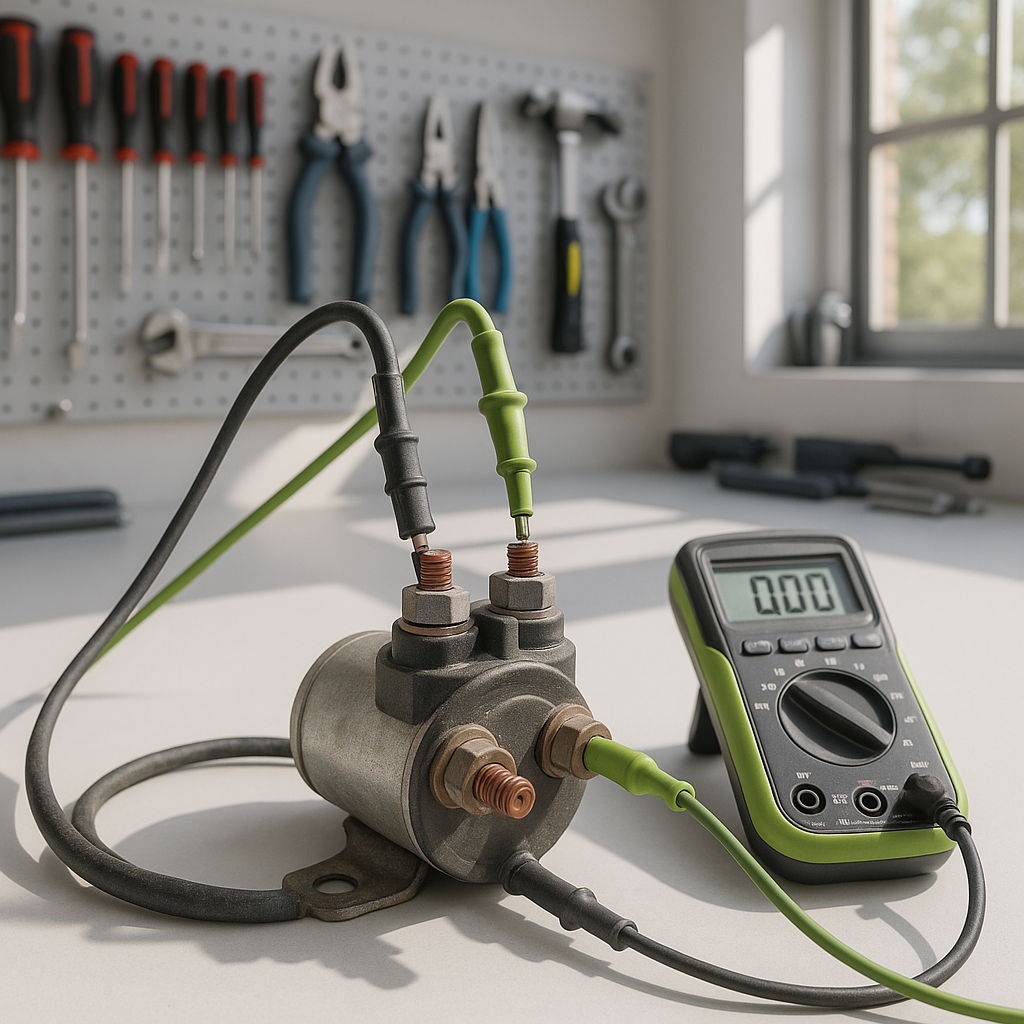
A dead solenoid is one of the most common reasons a golf cart won't move, but it's also one of the most misdiagnosed. The solenoid is essentially a high-current relay — when you press the accelerator, it receives a low-voltage signal that magnetically closes an internal switch, completing the circuit between your batteries and motor. When it fails, your cart either does nothing or behaves erratically. The good news: you can test a solenoid accurately with basic tools before spending money on a replacement.
What You'll Need
Grab a digital multimeter, a helper (someone to press the accelerator pedal while you probe), and a pair of insulated gloves. Safety first — you're working near a high-voltage battery pack, so disconnect any unnecessary circuits and treat every terminal as live until you've confirmed otherwise. Have your cart's wiring diagram handy if you can find one for your specific make and model; solenoid terminal layouts vary between manufacturers and voltage systems.
Step 1: Do a Visual Inspection First
Before you touch a multimeter, look at the solenoid itself. Check for obvious corrosion on the terminals, burnt or melted wiring, or cracked casing. Wiggle the large wire lugs — they should be tight. A loose connection at the solenoid is sometimes the entire problem, and retorquing those terminals costs nothing. Also look for any signs of heat damage on surrounding wires, which can indicate the solenoid has been working harder than it should — often a symptom of a failing unit drawing excess current.
Step 2: Listen for the Click
This is your first functional test. With the cart in the forward position and the key on, have your helper slowly depress the accelerator. Listen for an audible click from the solenoid. A healthy solenoid clicks when the coil energizes and the internal contacts close. No click at all points to a problem with either the coil side of the solenoid (the low-voltage trigger circuit) or no signal reaching it from the controller or accelerator. A click that's followed by nothing suggests the high-current contacts inside are worn or welded open. A solenoid that clicks but the cart still doesn't move is giving you valuable diagnostic information.
Step 3: Test the Coil Circuit with a Multimeter
Set your multimeter to DC voltage. The solenoid has two sets of terminals: small terminals (the coil/trigger side) and large terminals (the power/battery side). With the key on and the accelerator depressed, probe across the two small terminals. You should see voltage present — the exact value depends on your cart's system voltage, but you're confirming that the controller is actually sending a signal to energize the solenoid. No voltage here means the problem is upstream: check your key switch, safety switches, or accelerator position sensor before condemning the solenoid.
Step 4: Test the High-Current Contacts
Now check the large terminals — these carry the full battery current to your motor. With the key off and the cart at rest, set your multimeter to continuity or resistance mode and probe across the two large terminals. You should see no continuity (open circuit) when the solenoid is at rest. Next, have your helper press the accelerator to energize the solenoid, and probe again — you should now see continuity (closed circuit). If you see continuity at rest, the contacts are welded shut, which is a definite failure. If you get no continuity even when the solenoid clicks and the coil is receiving voltage, the internal contacts are burned out. Either way, the solenoid needs replacement.
Step 5: Voltage Drop Test (Advanced)
If the solenoid passes the basic tests but your cart still runs sluggishly or loses power under load, do a voltage drop test across the large terminals while the cart is under load. Set your multimeter to DC voltage, place one probe on each large terminal, and have someone drive the cart. In a healthy solenoid, you should see minimal voltage drop across those contacts — a significant reading means the contacts are worn and creating resistance. This is a sign the solenoid is failing even if it technically still works. High resistance in the power path robs performance and puts stress on the controller and motor.
When to Replace vs. When to Keep Investigating
If your solenoid fails any of the tests above — no click, coil not receiving signal, contacts welded or burned out, or high voltage drop — replacement is the right call. Solenoids are wear items, especially in carts that are used frequently or that have had battery or charging problems. However, if the solenoid tests clean and you're still having issues, the problem lies elsewhere: your motor controller, accelerator assembly, or motor itself. Don't throw parts at a problem you haven't tested your way through. A methodical test sequence saves money and gets you back on the course faster.